

Supreme Court Patches a Small but Apparent Hole in the First Step Act in Hewitt v. United States
July 21, 2025 Hewitt v. United States, 606 U.S. ____ (2025) (Jackson, J.) Response by Kyle Singhal Geo. Wash. L. Rev. On the Docket (Oct. Term 2024) Slip Opinion | SCOTUSblog Supreme Court Patches a Small but Apparent Hole in the First Step Act in Hewitt v. United States Federal law does not treat violent... Read More

Trump v. CASA, Inc.: A Non-Universal Response to the Universal Injunction Problem
July 10, 2025 Trump v. CASA, Inc., 606 U.S. ____ (2025) (Barrett, J.) Response by Alan B. Morrison Geo. Wash. L. Rev. On the Docket (Oct. Term 2024) Slip Opinion | SCOTUSblog Trump v. CASA, Inc.: A Non-Universal Response to the Universal Injunction Problem On the final day of the 2024 Term, the Supreme Court... Read More

FDA v. R.J. Reynolds: A Standing Decision that is a Major Victory for Corporate Forum Shopping
July 3, 2025 Food and Drug Administration v. R.J. Reynolds Vapor Co., 605 U.S. ____ (2025) (Barrett, J.) Response by Richard J. Pierce, Jr. Geo. Wash. L. Rev. On the Docket (Oct. Term 2024) Slip Opinion | SCOTUSblog Food and Drug Administration v. R.J. Reynolds: A Standing Decision that is a Major Victory for Corporate... Read More
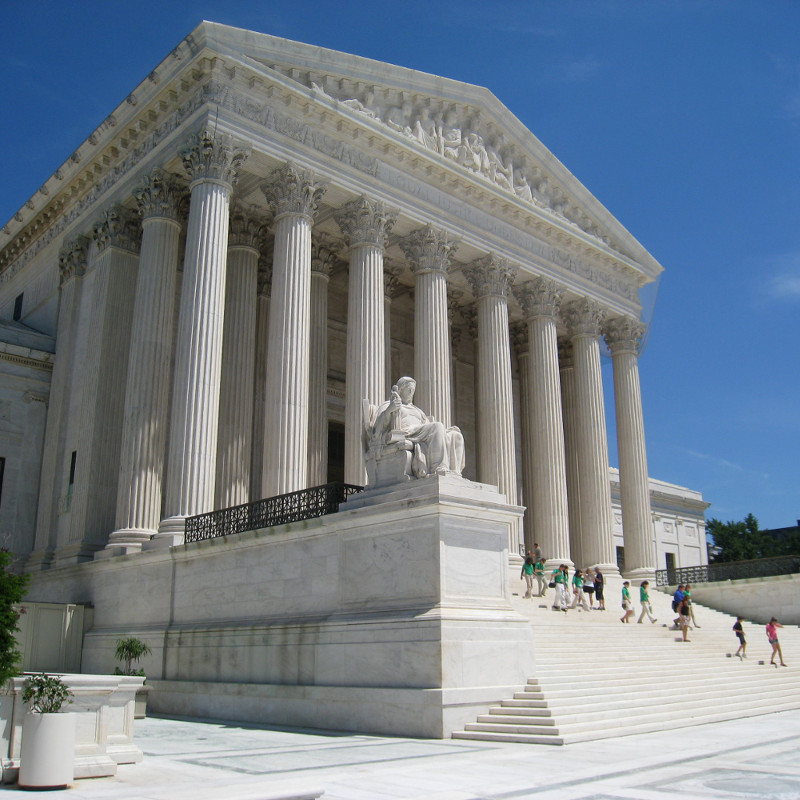
Supreme Court Confirms Limits of Federal Court Jurisdiction Regarding Nuclear Waste in NRC v. Texas
July 3, 2025 Nuclear Regulatory Commission v. Texas, 605 U.S. ____ (2025) (Kavanaugh, J.) Response by R. Budd Haemer Geo. Wash. L. Rev. On the Docket (Oct. Term 2024) Slip Opinion | SCOTUSblog Supreme Court Confirms Limits of Federal Court Jurisdiction Regarding Nuclear Waste in NRC v. Texas Wisdom passed down to young advocates preparing... Read More
Pro Bono Publico Versus Pro Bono Presidential
S.I. Strong 94 Geo. Wash. L. Rev. Arguendo 1 In March and April 2025, the Trump Administration issued a series of executive orders directed at various law firms that had represented clients or undertaken actions with which the President disagreed. Those executive orders imposed various sanctions capable of destroying the firms financially. The Administration also... Read More
How to Minimize the Risk of Collusion in the Wake of the CMS Hospital Price Publication Mandate
Lily V. Barrett 93 Geo. Wash. L. Rev. 701 In 2019, the Centers for Medicare and Medicaid Services (“CMS”) finalized a rule requiring hospitals to publish their prices for certain goods and services with the goal of encouraging price competition among hospitals and increasing affordability by increasing consumers’ ability to compare prices. Despite the admirable... Read More
Holding Influencers Accountable: When Election Disinformation Turns Criminal
Regina Postrekhina 93 Geo. Wash. L. Rev. 669 The harm that social media influencers and their election disinformation pose to American democracy may be novel to United States courts, but the damage has already been done. An influencer in the 2016 election manipulated almost 5,000 people into texting a number in place of a ballot,... Read More
A Revival of Nondomination in Antitrust Law
Sandeep Vaheesan 93 Geo. Wash. L. Rev. 610 For decades, the theme of nondomination has been largely absent from federal antitrust law. Beginning in the 1970s, the Supreme Court held that short-term economic efficiency would be the guiding principle of its interpretations of the Sherman Act. Limiting domination in economic life was dismissed as a... Read More
Student Privacy’s Student Neglect: Toward a Student-Centric Paradigm
Elana Zeide 93 Geo. Wash. L. Rev. 535 Student privacy law does not meaningfully protect students’ privacy. As federal statutes such as the Family Educational Rights and Privacy Act and the Protection of Pupil Rights Amendment mark their fiftieth anniversaries, they prove inadequate in an era of technology-mediated and data-driven education. More critically, student privacy... Read More
Taxing Litigation Finance
The emerging litigation finance industry has the capacity to expand access to justice but also raises important legal and ethical questions. The problem arises in classifying litigation finance contracts as either a nonrecourse loan, immediate sale, or variable prepaid forward contract, all of which discretely impact the timing and character of income. The consequences are tax uncertainty and an opportunity for taxpayers to engage in aggressive tax planning by structuring transactions to obtain favorable tax treatment without altering their economic position. This Article proposes a customized, multifactor analysis to identify the true nature of litigation finance transactions and impose proper tax treatment.
The bedrock of the proposal is the concept of tax ownership, which in the litigation finance context can be streamlined into two key factors: economic risk and legal control of the claim.