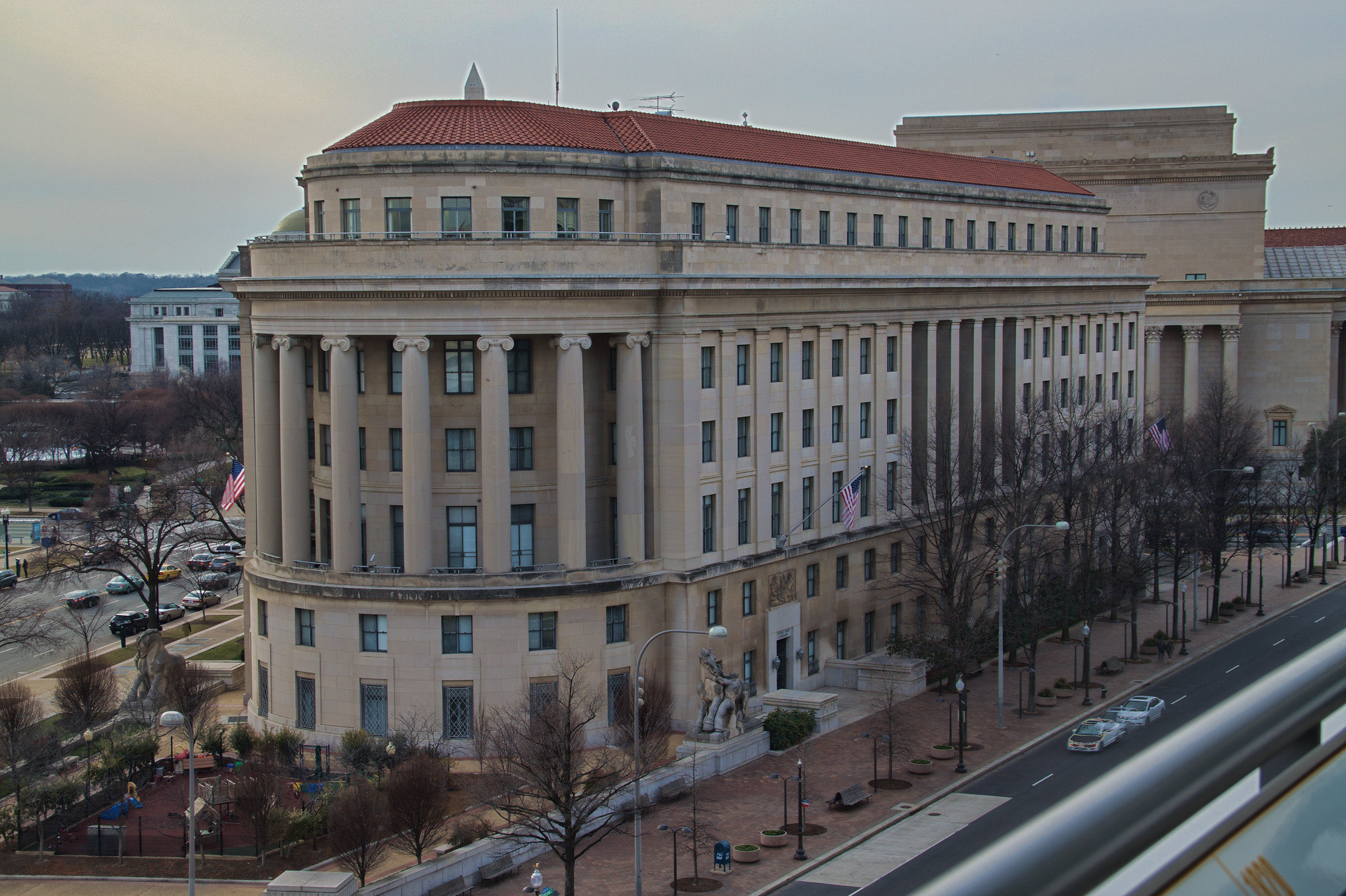
September 3, 2026
Trump v. Slaughter, 609 U.S. ____ (2026) (Roberts, J.)
Response by William E. Kovacic
Geo. Wash. L. Rev. On the Docket (Oct. Term 2025)
Slip Opinion | SCOTUSblog
Trump v. Slaughter and the Foreseeability of Disruptive Policy Events
In Trump v. Slaughter,1 the Supreme Court upheld President Donald Trump’s decision to dismiss Commissioner Rebecca Kelly Slaughter from the Federal Trade Commission (“FTC” or “Commission”) without cause.2 The decision’s larger effect is to give the President at-will termination authority over heads of independent regulatory agencies.3
At first glance, the outcome in Slaughter might appear to have been inevitable. In recent cases,4 the Court indicated it was minded to repudiate Humphrey’s Executor v. United States,5 which had rejected President Franklin Roosevelt’s attempt to remove the contentious William Humphrey from his position on the Commission simply on the basis of policy disagreement.6 Only a few observers, most of them former senior Commission officials, believed the Court might conclude this was a bad time to expand the President’s control over the previously independent regulatory agencies.
I was one of the few. I joined three other former FTC chairs in filing an amicus brief before the Court arguing that the administrative law framework established by Congress from the late 1940s forward represented a constitutionally valid allocation of accountability controls between the legislative and executive branches of government.7 From 1979 through 2011, I served in five separate roles at the Commission: staff attorney, attorney-advisor to a commissioner, general counsel, commissioner, and chair. These experiences, along with my academic research and nine years as a nonexecutive director with the United Kingdom’s Competition and Markets Authority, convinced me that although some of the factual assumptions on which the Court based its decision in Humphrey’s Executor were questionable, the Court’s intuition about the importance of for-cause removal protection was correct and consistent with the mandates of the Constitution.8
For me, the outcome and reasoning of Slaughter sting. The Court majority declined to wrestle with arguments that some protection against unjustified removal supported the effective functioning of the regulatory process while still giving the President significant means to influence agency behavior. The Court seemed to credulously embrace the fiction that, shielded by the rule in Humphrey’s Executor, FTC commissioners are unaccountable because they operate free of significant political control imposed from either end of Pennsylvania Avenue.9
The ruling in Slaughter does not end the drama surrounding the FTC’s legitimacy and constitutionality. The agency remains in the center of hurricane alley, and new storms approach. These include challenges to the agency’s substantive mandate as an unconstitutional delegation of authority, and due process attacks against the integration of functions that makes the Commission the prosecutor of cases and the ultimate adjudication tribunal within the agency.10 To the latter point, Slaughter raises the question of whether the mere possibility of political interference by the President in the tribunal’s decisions renders the FTC decision-making model inherently deficient.
Was the FTC a helpless victim in this series of events? The agency’s defenders, especially those of us who held senior leadership positions in the modern era, must ask whether the Commission should have seen the storms forming and taken precautions to protect itself. Would earlier identification of an emerging intellectual framework—namely, the unitary executive theory—have put the agency in a better position to shape the debate by stimulating the formulation of countervailing arguments and a supportive coalition?
The FTC may have been far too slow to recognize the institutional hazard presented by new skeptical theories of administrative power. Slaughter reveals a serious recurring weakness of regulatory authorities: inadequate ability to anticipate and forecast future policy storms. The ability to perform accurate forecasting is an essential capability for regulatory bodies. The forecasting function is vital to the larger process of strategic planning which, if carried out effectively, can enable the regulator to identify and address policy developments that, if left uncontested, could disable the agency’s programs and endanger its very existence.
Maybe the emergence and acceptance of the ideas that inspired the Court’s reasoning in Slaughter were unstoppable, and no amount of horizon scanning and forecasting could have averted the outcome. Yet weaknesses in the agency’s strategic planning framework permitted the onward march of the unitary executive theory to proceed without the degree of robust opposition, in ideas and tactics, that might have impeded or delayed its ascent.
Strategic Planning
Strategic planning is the process by which an agency makes decisions about what programs to pursue and how best to execute them. Effective strategic planning engages several disciplines. It studies the evolution of legal doctrine to understand the existing doctrinal framework, to comprehend the forces that shaped its evolution, and to know its strengths and weaknesses. A shrewd regulator uses economics to understand how proposed interventions might affect economic performance and stimulates affected interest groups to mount efforts to persuade courts and elected officials to forestall the agency. Strategic planning also draws upon political science to appreciate the political forces that influence the environment in which the agency operates. It invokes history to understand the consequences of past agency interventions and to anticipate the impact of similar interventions in new or anticipated programs.
Of all these tools, historical awareness may be the agency’s most valuable forecasting tool. History illuminates how new bodies of thought emerge and gain influence in policymaking. Strong historical awareness reveals how certain agency actions induce lobbying and related efforts to encourage elected officials to suppress or weaken the agency’s programs. This historical awareness illuminates the steps an agency can take to neutralize ideas that, if not taken seriously and contested vigorously, will threaten the agency’s programs and maybe the agency itself.
Forecasting and the Ascent of the Unitary Executive Theory
The unitary executive theory has older antecedents, but it assumed its modern form in the 1980s and early 1990s.11 An effective FTC strategic planning process would have comprehended that this body of thought could reshape the policy environment and therefore must be taken seriously, even if the agency regarded the theory as badly misguided. A new body of thought enjoys no advantage greater than being taken too lightly by the consensus status quo.
Good forecasting requires engagement with the new ideas as they emerge. The requisite engagement has several elements. One is to develop a deep familiarity with the new ideas—to take their arguments on their own terms and to understand their origins. A second element is to participate in events in which the new ideas are presented and debated. In many instances, the advocates of new perspectives create new policy networks and platforms that bypass existing institutions. The careful study of an intellectual movement’s formative literature, and knowledge of how and why the ideas took shape, can enable the agency to anticipate how the ideas might emerge and gain adherents. This is the regulatory agency equivalent of meteorology that spots new phenomena and tracks their progress.
Good forecasting alerts the regulator to potentially hostile theories and gives it a head start on creating counterarguments. The intended audience for these counterarguments is the elected officials who make decisions about an agency’s budgets and powers and the courts that will assess whether the agency has established an adequate basis for the exercise of its authority.
The modern history of the FTC contains painful examples of how new ideas blindsided the agency and its programs. The Commission of the 1970s failed to grasp the significance of the Chicago and Harvard schools and the possibilities for a major retrenchment of the agency’s programs.12 And since the early 2000s, the Commission has failed to grasp the significance of the Neo-Brandeisian school of thought and to appreciate that it foreshadowed a possible transformation of the agency’s programs.13
So too did the modern Commission fail to comprehend the potential impact of the unitary executive theory and to see how the gradual expansion of the agency’s powers and programs might fuel demands, consistent with the unitary executive theory, to repudiate Humphrey’s Executor and its requirement that Commission members be removed only for good cause; to see the threat to the integration of functions—prosecution and adjudication—on which the agency’s institutional design was premised in 1914; and, maybe most important, to understand how a continuing critical examination of how the agency has applied its broad, elastic substantive mandate—to proscribe unfair methods of competition and ban unfair or deceptive acts or practices—might inspire crippling attacks on the agency’s institutional design.
From 1970 to 2024, the FTC welcomed enhancements to its independent litigating authority (e.g., Section 13B of the FTC Act) and extensions of its remedial power.14 The FTC did not reflect upon how those steps arguably pulled the agency away from the model that guided the Supreme Court’s reasoning and decision in Humphrey’s Executor. Time after time, the agency took comfort in the perception that courts and the President regarded Humphrey’s Executor as immutable and thus an impenetrable bulwark against acceptance of the unitary executive theory as an organizing principle of public administration.
By the time the FTC caught on to the dangers posed by the unitary executive theory, it may have been too late to confront the theory effectively. A more robust systematic application of strategic planning and forecasting capabilities might have helped diminish the influence of the unitary executive theory.
Thus, the immediate crisis confronting the Commission provides a cautionary guide for regulatory agencies in the future. Slaughter is a good opportunity for regulators to assess themselves and build capabilities that will enable them to anticipate future challenges at an earlier stage and develop a strategy to oppose them. There was no inevitability that the unitary executive theory would gain so much influence that it would topple Humphrey’s Executor and support a broad rethink of the role of administrative agencies as a means for economic regulation. A complacent view of the durability of prevailing doctrine and an inattentiveness to how new ideas can collapse the status quo were serious institutional weaknesses. Maybe a more robust FTC response, grounded in better strategic planning and forecasting, might have been unavailing. We can be confident that the inadequacy of such measures and the reluctance to confront potential vulnerabilities raised the odds that the proponents of the unitary executive theory would prevail. This raises the troubling possibility that the Commission and its proponents may have lost not only a single important case. They may have contributed to the loss of an agency—their own.
William E. Kovacic is a professor at The George Washington University Law School. From January 2006 to October 2011, he was a member of the Federal Trade Commission and chaired the agency from March 2008 to March 2009. He was the FTC’s General Counsel from June 2001 to December 2004. In 2011 he received the FTC’s Miles W. Kirkpatrick Award for Lifetime Achievement.
Since August 2013, Professor Kovacic has served as a Non-Executive Director with the United Kingdom’s Competition and Markets Authority. From January 2009 to September 2011, he was Vice-Chair for Outreach for the International Competition Network. He has advised many countries and international organizations on antitrust, consumer protection, government contracts, and the design of regulatory institutions.
References
[1] 146 S. Ct. 2283 (2026).
[2] Id. at 2310–11.
[3] See id. at 2295–97.
[4] See, e.g., Free Enter. Fund v. Pub. Co. Acct. Oversight Bd., 561 U.S. 477, 492–93 (2010); Seila L. LLC v. CFPB, 591 U.S. 197, 215–17 (2020).
[5] 295 U.S. 602 (1935).
[6] Id. at 618–20.
[7] Brief of Bipartisan Former Chairs of the Federal Trade Commission as Amici Curiae Supporting Respondents, Trump v. Slaughter, 146 S. Ct. 2283 (2026) (No. 25-332). The brief was cited by Justice Sotomayor in her dissenting opinion, which was joined by Justices Kagan and Jackson. See Slaughter,146 S. Ct. at 2337. The brief also incorporated a number of arguments set out in Andrew I. Gavil & William E. Kovacic, A Defense of the “For Cause” Termination Provisions of the Federal Trade Commission Act, Progressive Pol’y Inst. (July 16, 2025), https://www.progressivepolicy.org/a-defense-of-the-for-cause-termination-provisions-of-the-federal-trade-commission-act/ [https://perma.cc/7GPZ-AMHY].
[8] Brief of Bipartisan Former Chairs, supra note 7, at 18–22.
[9] See Slaughter, 146 S. Ct. at 2310.
[10] See, e.g., Slaughter, 146 S. Ct. at 2304 (calling the FTC’s statutory mandate “startlingly abstract” and its power to investigate and prosecute cases “quintessentially executive”).
[11] See Morrison v. Olson, 487 U.S. 654, 697–734 (1988) (Scalia, J., dissenting); Steven G. Calabresi & Saikrishna B. Prakash, The President’s Power to Execute the Laws, 104 Yale L.J. 541, 570–79 (1994).
[12] See William E. Kovacic, Root and Branch Reconstruction: The Modern Transformation of U.S. Antitrust Law and Policy, 35 Antitrust 46, 52 (2021).
[13] See William E. Kovacic, Antitrust, Transformation, and Enduring Policy Change, 49 J. Corp. L. 321, 322–23 (2024).
[14] See 15 U.S.C. § 53(b) (2018).