

A State Court Trial Judge’s Thoughts on Samia v. United States: Not Entirely Consistent with Crawford v. Washington
Samia promotes judicial economy at the cost of the Sixth Amendment’s right of confrontation.
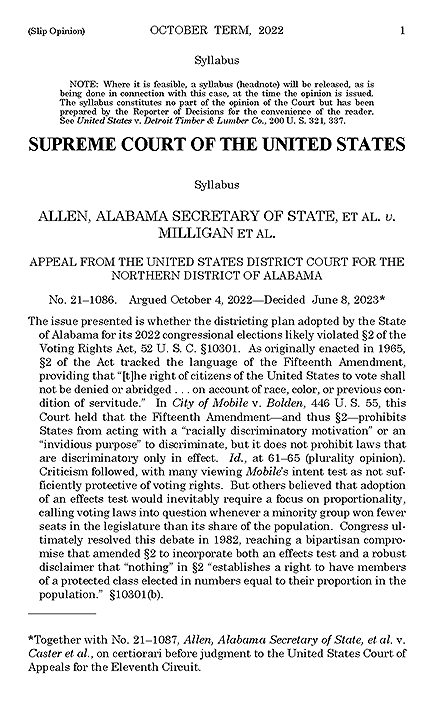
The Surprising Success of the Alabama Plaintiffs in the Voting Rights Case Allen v. Milligan
In the recent Supreme Court term, the conservative majority on the Court prevailed on a significant number of controversial decisions. In the area of minority voting rights, however, the Court surprised experienced observers by ruling in favor of Alabama minority plaintiffs in a major redistricting case.

How Stalking Became Free Speech: Counterman v. Colorado and the Supreme Court’s Continuing War on Women
The Counterman decision suggests that when it comes to women’s speech and safety, the more intractable problem with the current Supreme Court is not the forces that divide it, but those that unite it.

The Real and the Phantom 303 Creative: Which Is More Dangerous?
Professor Catherine J. Ross emphasizes the majority's narrow holding over the dissent's parade of horribles in response to 303 Creative v. Elenis.
JRAD Redux: Judicial Recommendation Against Immigration Detention
Mary Holper 91 Geo. Wash. L. Rev. 561 There is a dire need for bail reform in the immigration detention system. Scholars have suggested a variety of recommendations to improve the manner in which immigration detention decisions are made. All of these recommendations have rested on the assumption that there is a finite pool of... Read More
Hortatory Mandates
Nathan Cortez & Lindsay F. Wiley 91 Geo. Wash. L. Rev. 617 This Article is the first to describe “hortatory mandates” and articulate principles for judicial review. Hortatory mandates are laws whose form and function collide. Either they speak in mandatory terms but lack penalties or enforcement mechanisms, or they speak in hortatory, precatory terms... Read More
The Case for Taxing Away Unsustainable Profits
Allison Christians & Tarcísio Diniz Magalhães | 91 Geo. Wash. L. Rev. 697 | When businesses offload environmental and social costs on the public, the resulting profits are windfalls extracted from current and future taxpayers. Prevailing regulatory and tax remedies have not only failed to eliminate such profiteering, but they have in fact incentivized it. To prevent some from receiving windfalls while everyone else bears the costs, profits can be distinguished between sustainable profits, when costs are internalized, and unsustainable profits, when costs are externalized. While the former would remain subject to the traditional corporate income tax, the latter should be completely taxed away with a surtax. A viable way to achieve this is to combine advanced mechanisms for measuring environmental and social damage across supply chains with classic and emerging legal techniques for differentiating categories of income for tax purposes. Mobilized through the income tax system, these tools can be used to design a cutting-edge windfall tax on unsustainable profits. This Article makes the normative and practical case for doing so.
Severe or Pervasive Meet Petty or Trivial: Lowering the Standard for Establishing a Hostile Work Environment Sexual Harassment Claim Under Title VII
Caroline Sinegar 91 Geo. Wash. L. Rev. 755 Legislators across the country have passed state and federal statutes to provide relief to victims of sexual harassment in the workplace. At the state level, there is little uniformity regarding how victims are protected or what kind of behavior constitutes a hostile work environment sexual harassment claim.... Read More
A Plaintiff’s Cryptonite: Charting a Path Forward for Minimum Contacts in the Cryptocurrency Era
Mallory Mecklenburg 91 Geo. Wash. L. Rev. 785 American interest in cryptocurrency has gone to the moon. As of November 2021, sixteen percent of American adults have invested in or traded cryptocurrency. But interest is not projected to stop there—continued use will more than triple the international cryptocurrency market by 2030. Indeed, new research has... Read More
Involuntary Work Program: Imposing Liability on Immigration Detention Center Contractors
Molly Muoio · July 2023 91 Geo. Wash. L. Rev. Arguendo 41 Abhorrent conditions and human rights violations in U.S. migrant detention centers have garnered significant public outcry. Articles and activists have decried “kids in cages” and family separations at the southern border. Yet little attention has been paid to a longstanding administrative program that... Read More