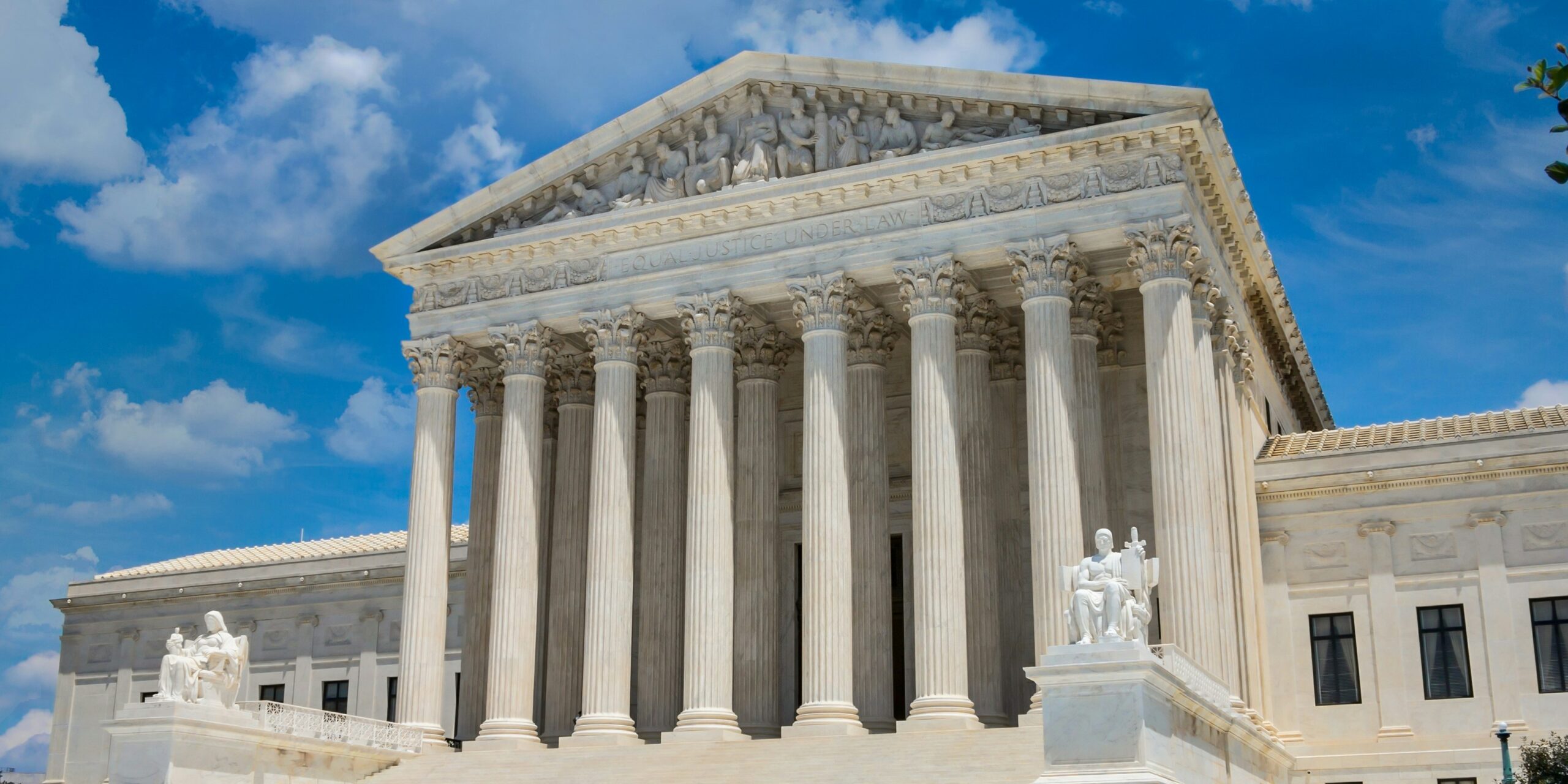
As the 2025 Supreme Court Term continues, the Justices will hear arguments in numerous important cases, from the scope of governmental immunities to critical questions of procedure to capital punishment. This post previews key cases that will be argued in the November Sitting and later in the Term.
Table of Contents
Hencely v. Fluor Corporation
No. 24-924, 4th Cir. (Argument Nov. 3, 2025)
Preview by Sonia Stadler, Member
In Hencely v. Fluor Corporation, the Court will decide whether a government contractor can be sued for the conduct of one of its employees under state tort law. See Brief for Petitioner at i.
The case arises from an incident that took place on a U.S. military base in Afghanistan. The Respondent, Fluor, is a government contractor who hired Afghan local Ahmad Nayeb to work on the base. Brief in Opposition at 1, Hencely, No. 24-924. Nayeb built an explosive vest during work and detonated it at a 5K race, killing five people and wounding more than twelve others. Brief for Petitioner at 1. One of the wounded soldiers was Petitioner Winston Hencely who sued Fluor under state tort law for its negligence in hiring and supervising Nayeb. Id.
The Court will decide if Hencely’s claim is preempted by an exception to the Federal Tort Claims Act (“FTCA”), which allows citizens to sue the United States in civil court for damage caused by the negligence of government employees acting in the scope of their employment. 28 U.S.C. § 1346(b)(1). One exception, Section 2680(j), immunizes the government for “[a]ny [tort] claim arising out of the combatant activities of the military or naval forces . . . during time of war”—known as the “combatant activity” exception. In Boyle v. United Technologies Corp., the Supreme Court said the government had “uniquely federal interests” allowing contractors to be immune under the combatant activity exception even though the exception does not usually apply to government contractors. Brief for Petitioner at 10. Here, the court below ruled that this exception applied because Fluor was contracting on a military base during war, and the military maintained authority over them. Id at 11.
Hencely asks the Court to reverse for three reasons. First, the combatant activity exception does not apply because the FTCA expressly does not apply to government contractors. Id. at 23–27. Second, no conflict exists between the FTCA and suing Fluor for violating state-law duties of care. Id. at 17–27. Third, Boyle should not be extended because it was decided without a strong basis in the Constitution or a federal statute and does not apply to government contractors who violate their contract. Id. at 31–55.
First, Fluor responds that appellate courts have correctly ruled that the combatant activity exception can preempt tort claims against a government contractor. Brief for Respondent at 14–24. Second, even if the circuit courts decided those cases with different reasoning, Fluor is immune under every test they used. Id. at 24–30. Third, state law has no place in governing this military situation abroad, and therefore there is a great federal government interest in preempting the state law claims. Id. at 30–46.
The case is scheduled for argument on November 3, 2025. Its outcome could have great implications for the liability government contractors face for the behavior of their employees.
Coney Island Auto Parts Unlimited, Inc. v. Burton
No. 24-808, 6th Cir. (Argument Nov. 4, 2025)
Preview by Katherine Cassidy, Member
In Coney Island Auto Parts Unlimited, Inc. v. Burton, the Supreme Court will address whether Federal Rule of Civil Procedure 60(c)(1) imposes any time limit on setting aside a void default judgment for lack of personal jurisdiction. Petitioner is Coney Island Auto Parts Unlimited Inc., a New York corporation. Respondent is Jeanne Ann Burton, the Chapter 7 Trustee for Vista-Pro Automotive, LLC.
Vista-Pro Automotive, LLC was an auto-parts corporation that entered bankruptcy five years after its formation in 2009. See Brief for Respondent at 2–3. At that time, Vista-Pro started a case under Chapter 11 in bankruptcy court in Tennessee and later filed a claim against Coney Island to recover unpaid invoices. See Brief for Petitioner at 2. Vista-Pro addressed the summons and complaint to Coney Island as a corporation, rather than a particular officer or agent, and used regular mail service to serve the summons and complaint on February 23, 2015. See id. at 3. Coney Island asserts that Vista-Pro failed to comply with Federal Rule of Bankruptcy Procedure 7004(b)(3), arguing that the rule requires the mail be addressed to a specific officer or agent. See id. Coney Island did not respond, and Vista-Pro moved for a default judgment, which the bankruptcy court granted. See id.
In 2016, the case transitioned to a Chapter 7 liquidation proceeding and a trustee, Jeanne Ann Burton, was designated. See id. Burton registered the declaratory judgment in New York in 2021 after unsuccessful attempts to collect the debt. See Brief for Respondent at 5–6. Coney Island moved to vacate, claiming that the Tennessee bankruptcy court lacked personal jurisdiction, which was unsuccessful. See Brief for Petitioner at 4. Coney Island then filed a Rule 60(b)(4) motion to vacate the default judgment in the Tennessee bankruptcy court later that year. See Brief for Respondent at 6. The bankruptcy court denied the motion and the Sixth Circuit affirmed, holding that the motion to vacate the judgment was not made within a reasonable time as required by Rule 60(c)(1). See id. at 7.
Petitioner Coney Island argues that it was served improperly because of the lack of identified agent or officer on the addressed mail and that proper notice has been a condition for personal jurisdiction since cases as early as Pennoyer v. Neff. See Brief for Petitioner at 11. Petitioner asserts that the decision is void because “a judgment entered in the absence of personal jurisdiction is void when entered and remains so forever.” Id. at 12. Thus, Coney Island’s delayed Rule 60(b)(4) motion to vacate is valid, as to hold it otherwise would give the Respondent an “enforceable judgement” on a void decision. Id. at 9. To put it simply, “[i]f a judgment is void immediately upon entry, how could the passage of time vivify it?” Id. at 7.
Conversely, Respondent Burton asserts that Rule 60(c)(1) clearly states that motions under the rule must be made in a reasonable amount of time and that allowing Petitioner to bring a motion to vacate several years after default judgment would create uncertainty and instability within the litigation process. See Brief for Respondent at 2, 21. Respondent emphasizes that Petitioner filed its motion to vacate six years after notice of the judgment and has not explained any reason for the extended delay. Id. at 6. Respondent disagrees with Petitioner’s assertion that there is an “entrenched split” among the circuits on this issue, as most motions in the cases Petitioner references were later denied on other grounds. Brief in Opposition at 16. Respondent explained that issues related to reasonableness of delayed filings with Rule 60(b)(4) motions are rarely outcome determinative, including in multiple cases cited by the Petitioner in its brief. Id. at 8–9.
Although this case may seem niche, allowing a motion to vacate for lack of personal jurisdiction years after a declaratory judgment could have broad implications for litigation strategy and feelings of finality for parties. The Court’s decision in this case could shape the ways that litigants revive cases potentially years after judgments have been made.
Learning Resources, Inc. v. Trump
No. 24-1287, D.D.C. (Argument Nov. 5, 2025)
Preview by Thomas Montano, Member
In Learning Resources, Inc. v. Trump, No. 24-1287, consolidated with Trump v. V.O.S. Selections, No. 25-250, the Court will tackle whether the International Emergency Economic Powers Act, 50 U.S.C. § 1701 (“IEEPA”), authorizes the President to invoke tariffs on foreign countries during a designated national emergency.
In 1977, Congress passed IEEPA, which enables the president, after declaring a national emergency, to address an “unusual and extraordinary threat” with a source outside the United States through a variety of means. Pet. for Writ of Cert. Before J. (“Pet.”) at 4–5. The list of authorized means does not explicitly include laying tariffs. 50 U.S.C. § 1702. Since its inception, IEEPA has been invoked by presidents to levy sanctions on both foreign governments, such as Iran and Cuba, and foreign persons who have been designated as members of terrorist organizations, corporations, or foreign political parties. Id. at 6. In February 2025, President Trump invoked IEEPA’s authorization through a series of executive orders to “regulate” the “importation” of “any property” to address two national emergencies: (1) the flow of contraband, such as fentanyl, into the United States and (2) the trade deficit in bilateral trading relationships. See Br. for Resp’ts in Opp’n. (“Opp’n”) at 2–3. In April 2025, the Trump administration invoked IEEPA on almost all trading partners to levy reciprocal tariffs, which were paused in part in the following month. Pet. at 8–9. Petitioner Learning Resource alleges that the tariffs will cost $100 million, a forty-four-times increase from 2024. Id. at 14.
Petitioner Learning Resources sued in the District Court for the District of Columbia in April 2025. The district court ruled that it had subject matter jurisdiction because the IEEPA does not grant the president authority to impose tariffs; therefore, the Court of International Trade (“CIT”) does not have exclusive jurisdiction over the matter. Opp’n at 8. The district court granted a preliminary injunction, reasoning that Petitioner was likely to win on the merits because IEEPA does not authorize the president to impose tariffs and that Petitioner would suffer irreparable harm without the injunction. Pet. at 14–15. CIT heard a concurrent challenge from Petitioners V.O.S. Selections and twelve states; that court concluded only that IEEPA did not authorize the reciprocal tariffs. Reply Br. for Pet’rs at 6.
Petitioners argue that IEEPA’s authorization to “regulate importation” does not include the power to impose tariffs, and the administration’s interpretation of the statute is not consistent with the plain text, history, or constitutional separation of powers. Pet. at 19. Because Article I, Section 8 of the Constitution grants Congress the power to lay taxes, the granting of unreviewable tariffs may be an impermissible delegation of Congress’s legislative power. Id. at 23. Petitioners also argue that tariffs are a tax and IEEPA only gives the president authority to “regulate,” which would have been understood by the enacting Congress as the authority to “control by rule or subject to restrictions.” See id. at 19–20. Highlighting that IEEPA lacks an express authorization to levy tariffs, Petitioners argue further that historically, no president has ever enacted a tariff without invoking a statute that explicitly grants the president that authority, and by doing so here the President implicates the Court’s major question doctrine. See id. at 22–23.
The Trump Administration argues instead that the tariffs are not a tax, but only a “monetary exaction” that is meant to adjust or control trade, which falls under the president’s authority to “regulate”—a broad term Congress intended to include these “monetary exactions.” Opening Brief for Respondents (“OBR”) at 23–24. Primarily, the Administration relies on “regulation” being paired with “importation” in a foreign affairs delegation to the president, which includes tariffs as a “traditional and commonplace way to regulate importation.” Id. at 31. The Trump Administration has also asked the Court to decide whether IEEPA is an unconstitutional congressional delegation of legislative power and whether the district court, rather than the CIT, had subject matter jurisdiction over Learning Resources’s complaint. Id. at 43–49.
The Court’s decision will have a consequential impact on the Trump Administration’s priorities, which have included massive tariffs both to raise revenue and to serve as a foreign policy tool. Furthermore, this is a case of first impression regarding whether the Roberts Court’s major question doctrine applies to areas of foreign policy or to the Trump Administration more broadly. Lastly, the case raises the dormant nondelegation doctrine, which has not been used to invalidate a law since the Roosevelt Administration. Although the Court rejected a challenge on similar grounds last term, a holding that invalidates IEEPA on nondelegation grounds could destabilize the entire administrative state and regulatory regime in the years to come.
Landor v. Louisiana Department of Corrections and Public Safety
No. 23-1197, 5th Cir. (Argument Nov. 10, 2025)
Preview by Anthony Booth, Member
In Landor v. Louisiana Department of Corrections and Public Safety, the Supreme Court will consider whether the Religious Land Use and Institutionalized Persons Act of 2000 (“RLUIPA”) allows an individual to sue government officials in their individual capacities for damages for violations of the act. This question involves two considerations: Is that cause of action supported by the text, and does such an interpretation lead to a constitutional outcome? The Petitioner claims “yes” to both while the Respondents focus more effort on claiming that such an interpretation would be unconstitutional. Brief for Petitioner at 16, 30; Brief for Respondent at 7, 47.
This case originally arose after Damon Landor finished a five-month period of incarceration in Louisiana state prisons. Brief for Petitioner at 8, 10. Landor is a Rastafarian who has taken the Nazarite Vow, promising never to cut his hair, and he had kept his vow for around twenty years prior to his incarceration. Id. at 8. After the first four months of his incarceration, Landor was transferred to another prison where he informed the intake officials of his vow, but they forced him to cut his hair anyway. Id. at 9. When Landor was released around a month later, he filed a suit for damages under RLUIPA against a number of actors, including the warden of the final prison in which he was incarcerated, the Secretary of Louisiana’s Department of Corrections and Public Safety, and several John Doe guards in their individual capacities. Id. at 10. The district court dismissed the complaint and the Fifth Circuit affirmed, holding the injunctive relief claims were moot and individual-capacity damages were not allowed by RLUIPA. Id.
Petitioner argues first that RLUIPA’s language is clear and unambiguous in its authorization of a cause of action against officials as individuals. Brief for Petitioner at 16. Petitioner bases this argument on the similarities between RLUIPA and the Religious Freedom Restoration Act (“RFRA”) and the Supreme Court’s interpretation of RFRA. Id. He highlights that RFRA and RLUIPA contain almost identical language and were passed in very similar contexts and that the interpretation of such sister statutes should be consistent. Id. at 16–17. After arguing for parallel interpretation, Petitioner points out that RFRA has been interpreted by the Supreme Court in Tanzin v. Tanvir, 592 U.S. 43 (2020), to allow individual claims for damages against government officials. Id. at 18. Petitioner argues that the text is clear, damages are appropriate and the only effective remedy, and sovereign immunity does not apply here. Id. at 18–24.
Petitioner further argues that the individual-capacity damages are constitutional. Id. at 30. This argument rests on Respondents being “officers and agents of a federally-funded state program,” which means they are bound by federal law that restricts that funding, provided those restrictions are constitutional. Id. at 31. Petitioner argues that the standard from South Dakota v. Dole is satisfied because “RLUIPA and its remedies advance the general welfare,” “unambiguously allow[] individual-capacity damages,” are “strongly ‘related to’ Congress’s purpose,” and are not coercive to the state. Id. at 33–35. Additionally, the Necessary and Proper Clause, it is argued, extends Congress the authority to authorize damages as a remedy by extending the power to enforce actions taken under its spending power. Id. at 36. Petitioner then argues that the fact that the agents were not direct recipients of federal funds did not preclude their liability, as the Fifth Circuit had held, and that liability extending to such agents is normal. Id. at 38, 44. In closing, Petitioner argues that even a direct recipient rule could allow liability since contracts can “bind the agents of a counterparty” to the terms of a contract, including any resulting liability. Id. at 47.
Respondents address both the textual argument and the constitutional challenge—which are often intertwined as they invoke a version of the canon of constitutional avoidance. See Brief for Respondents at 6, 18, 30. Respondents first assert that a comparison between RFRA as interpreted in Tanzin and RLUIPA is inappropriate because it leads to unconstitutional results, and so the portion of RLUIPA which mirrors RFRA and formed the basis of Tanzin—the definition of government officials, which includes “nonofficial[] acting under color of law”—is unconstitutional. Id. at 7–8. Respondents acknowledge that the language in RLUIPA is “materially identical” to that of RFRA, but they argue that applying this language here extends spending-power conditions to nonparties to the spending contract, which makes the imposition of damages against the individuals unconstitutional. Id. at 8. Respondents argue the officials are nonparties because they are not recipients of the spending contract. Id. at 11. They further argue that allowing imposition of spending conditions on nonparties “would raise serious constitutional problems” because it would allow states to deprive their citizens of liberty simply by accepting an award, and it would allow private recipients to “supplant state law” through contracts with the federal government. Brief for Respondents at 19–22. Because they think the spending clause argument fails, Respondents also reject the Necessary and Proper Clause argument. Id. at 23.
Respondents further argue that Congress’s lack of a “clear-statement” means that officials in an individual capacity are clearly not liable under RLUIPA. Brief for Respondents at 30, 35. In searching for “absolute, exceeding, and unmistakable clarity,” Respondents argue that the statute comes up short because it could not, constitutionally, extend liability to nonofficials, so it does not clearly extend liability to officials in their personal capacities. Id. at 35–38. Additionally, Respondents argue that “appropriate relief” does not clearly authorize damages because it could mean equitable relief and relief would not be meaningless if only equitable relief were allowed. Id. at 38, 43–44. Additionally, Respondents argue that affirmance is appropriate even if an individual-capacity damages claim against officials was authorized because this application would exceed Congress’s constitutional spending power and because all states have entered the spending-power contracts under the belief that individual-capacity claims will be allowed. Id. at 45–46.
The GEO Group, Inc. v. Menocal
No. 24-758, 10th Cir. (Argument Nov. 10, 2025)
Preview by Thomas Witcher, Member
The issue before the Supreme Court in The GEO Group, Inc. v. Menocal is whether an order denying a government contractor’s claim of derivative sovereign immunity can be immediately appealed under the collateral-order doctrine.
GEO contracts with U.S. Immigrations and Customs Enforcement (“ICE”) to operate privately owned prisons detaining individuals awaiting immigration proceedings or removal. Menocal v. The GEO Group, Inc., 635 F. Supp. 3d 1151, 1158 (D. Colo. 2022). GEO’s contract requires it to administer a Voluntary Work Program for detainees with ICE subsidizing a daily one dollar wage. Id. Additionally, GEO’s handbook requires detainees to clean the entire prison without pay or be sent to solitary confinement. Id. at 1162–66. Upon his release in 2014, Menocal sued GEO for unjust enrichment and violations of the Trafficking Victims Protection Act’s (“TVPA”) forced labor provision. Id. at 1157–58. GEO claimed their contract with ICE granted them sovereign immunity under Yearsley v. W.A. Ross Construction Co., 309 U.S. 18 (1940), in which the Court held that contractors are absolved of liability for following government orders when the work performed was within Congress’s constitutional power and the contractor performed at the government’s direction. Id. at 1172–73. However, the Colorado District Court denied this claim. Id. at 1171. GEO then appealed this intermediate decision, but the Tenth Circuit dismissed the appeal for lack of jurisdiction. Brief for Respondent at 15.
Under 28 U.S.C. § 1291, appellate jurisdiction is limited to a district court’s final decision, but in Cohen v. Beneficial Industrial Loan Corp., 337 U.S. 541 (1949), the Supreme Court carved out a limited exception called the collateral-order doctrine to allow immediate appeal of intermediate decisions which are sufficiently important and collateral to the case’s merits. Id at 1. The Tenth Circuit ruled GEO’s Yearsley claim was not a collateral order; thus, there was no jurisdictional basis for the appeal. Brief for Petitioner at 10.
Petitioners argue derivative sovereign immunity meets the Cohen factors, as failure to satisfy the Yearsley conditions would subject the contractor to discovery and trial, which could be unnecessary if the ruling was reversed on appeal. Brief for Petitioner at 12. Further, GEO argues the Yearsley conditions are distinct from the underlying cause of action, despite some overlap between the merits and questions regarding immunity. Id. at 12–13. Lastly, Petitioners argue that when Congress and executive agencies use contractors to carry out legislation, litigation against contractors impairs the nation’s policy goals and should be resisted pursuant to separation of powers principles. Id. at 13.
Respondents argue that Yearsley does not grant contractors derivative sovereign immunity, as this would grant every government contractor, even those that merely trim government trees, sovereign immunity. Brief for Respondent at 15–16. Rather, Yearsley expanded traditional agency-law principles to apply to public agents as well as private agents. Id. at 17. Furthermore, respondents argue Yearsley cannot conform to the collateral-order doctrine because assessing the case’s merits is fundamental to the Yearsley factors, as the court needs to assess what the defendant did and the degree of the government’s involvement. Id. at 18.
Although the Court will not resolve the underlying issue of whether GEO violated the TVPA, this decision will have far-reaching impacts on government contractors. Derivative sovereign immunity would give contractors an additional avenue to defend themselves, though additional appeals may further lengthen litigation efforts for plaintiffs like Menocal who have been suing GEO since 2014.
Olivier v. City of Brandon
No 24-993, 5th Cir. (Argument Dec. 3, 2025)
Preview by Miles Hurley, Member
In Olivier v. City of Brandon, the Court asks a fundamental question of procedure: When and how should one sue to protect one’s rights? It does so by asking whether the seminal § 1983 case, Heck v. Humphrey, bars claims for purely prospective relief from a law that a plaintiff had been punished under, or for cases where plaintiffs had no access to habeas relief.
On May 1, 2021, Evangelist Gabriel Olivier was informed by a law officer that the city of Brandon, Mississippi, had passed an ordinance restricting demonstrations near the amphitheater to a designated “protest area.” Petitioner’s Brief at 7. Olivier complied, but finding the protest area smaller, further away, and restrictive to his preaching, he returned to speak at his original spot and was arrested. Id. at 7–8. He pled nolo contendere to the charge, paying a small fine and receiving a ten-day sentence which was suspended to a year’s probation, a condition of which was compliance with the ordinance. Respondent’s Brief at 4. Olivier did not appeal his conviction but instead sued for an injunction preventing the city from enforcing the ordinance on First Amendment grounds four months into his probation. Petitioner’s Brief at 8. Both the Northern District of Mississippi and the Fifth Circuit denied his request, claiming that Heck barred him from filing a § 1983 suit that would necessarily invalidate his earlier conviction. Olivier v. City of Brandon, No. 22-60566, 2023 WL 5500223 (5th Cir. Aug. 25, 2023).
A critical civil rights enforcement mechanism, § 1983 provides an individual cause of action for damages or equitable relief against officials acting under color of state law who deprive the “rights, privileges, or immunities secured by the Constitution and laws” of an individual. 42 U.S.C. § 1983. Heck v. Humphrey considered whether Indiana prisoner Roy Heck could bring a § 1983 damages claim while he was still exhausting his state appeals, which is necessary to challenge an unconstitutional confinement under the federal habeas statute. 512 U.S. 477, 479 (1994); 28 U.S.C. § 2254. The Court denied Heck’s appeal, holding that plaintiffs could not bring a § 1983 suit that would necessarily invalidate an otherwise lawful conviction. 512 U.S. at 483. Drawing a comparison to malicious prosecution suits at common law, Justice Scalia argued that allowing parallel § 1983 suits would imperil the validity of final court findings and create methods to collaterally attack valid state convictions in federal courts. Id. at 483–90.
Olivier characterizes his claim for an injunction as a “heartland” § 1983 concern, drawing on § 1983’s text and legislative history and the extended history of similar First Amendment claims under § 1983. Petitioner’s Brief at 16–19. Leaning on the Court’s opinions in Wilkinson v. Dotson and Wooley v. Maynard, he argues that because purely prospective relief only seeks to prevent further prosecution from an unconstitutional statute, it does not necessarily invalidate a prior conviction and avoids creating a collateral attack on a conviction. Id. at 22–26. He also notes the dissimilarity of pure prospective relief claims from historical actions with favorable termination requirements and warns that a verdict for Respondents would require a plaintiff to immediately challenge unconstitutional conduct or lose their right to sue. Id. at 29–30, 36–37. On the second issue, Olivier acknowledges Heck’s role in protecting the federal habeas statute but argues that in his case, a § 1983 suit was not incompatible with its essence as a mechanism “to attack the validity of [a] confinement.” Id. at 41–42. He further argues that because he was never in custody and therefore never eligible for habeas relief, requiring a favorable termination would leave him without an available constitutional remedy, weakening his underlying First Amendment right. Id. at 44–48.
Respondents tackle the issues in reverse, arguing that probation is a form of custody that requires Olivier to seek habeas relief, direct or postconviction appeal, expungement, or pardon before § 1983 relief. Respondent’s Brief at 11, 17–18. More substantively, they assert that a plaintiff’s custodial status is irrelevant both because it does not affect Heck’s core anticollateral attack purpose and does not have a basis in common tort law. Id. at 11–16. Attacking Olivier’s injunction, Respondents argue that constitutional avoidance precludes a decision on the “purely prospective relief” question because Olivier failed to raise it earlier. Id. at 19–23. They further argue that Olivier’s challenge impacts his sentence directly due to his probation and indirectly by making the ordinance facially unconstitutional and thus voiding his prior conviction. Id. at 27–38. Finally, Respondents plead for a broad bright-line favorable termination rule, arguing that the core rules of federalism, comity, and finality require its universal application. Id. at 39–73.
In his concurrence in Heck, Justice Souter criticized the majority’s silence on how far this bar ultimately reached. 512 U.S. at 501–02 (Souter, J., concurring in the judgment). In the years to follow, the circuits have disagreed on Heck’s breadth in numerous ways, many of which have been left unresolved. Compare Martin v. City of Boise, 920 F.3d 584 (9th Cir. 2019) with Clarke v. Stadler, 154 F.3d 186 (5th Cir. 1998) (en banc). Beyond merely solving a circuit split, the Court’s decision here could further limit the already dwindling scope of § 1983. See, e.g., Medina v. Planned Parenthood South Atlantic, 145 S. Ct. 2219. Consider a middle school teacher criminally convicted of teaching her class about LGBTQ+ history under a restrictive state law and fined $300. Should Olivier lose both prongs in this case, this hypothetical teacher would have no mechanism to seek protection from further prosecutions and could rack up fine after fine, all of which would come due if she could not win her first challenge. She faces a catch-22: speak and risk serious financial injury, or silence herself due to an unconstitutional law she cannot afford to challenge.
Hamm v. Smith
No. 24-872, 11th Cir. (Argument Dec. 10, 2025)
Preview by Alexis Coletti, Member
No one disputes that Joseph Clifton Smith killed Durk Van Dam, but whether Smith will be executed for his crime involves more math than one might expect. In Hamm v. Smith, the Supreme Court will decide how to evaluate multiple IQ scores when considering a death row inmate’s claim of intellectual disability.
In Alabama in 1997, Smith drove Durk Van Dam into the woods and killed him. Physical evidence and eyewitnesses connected Smith to the crime, and he confessed to police. Brief for Petitioner at 15. Smith was convicted at trial, but at sentencing, he raised his diminished mental capabilities as a mitigating factor. Nonetheless, Smith was sentenced to death. Id. at 18.
Smith’s claim of diminished mental capacity directly involves the Supreme Court’s landmark decision in Atkins v. Virginia. There, the Court held that executing an intellectually disabled person violates the Eighth Amendment. Atkins v. Virginia, 536 U.S. 304, 321 (2002). However, the Court did not describe how to evaluate whether someone is intellectually disabled. Instead, the Court allowed the states to determine their own criteria. Id. at 317. The Court has never explained how to evaluate multiple IQ scores under Atkins. Brief for Respondent at 2.
In response to Atkins, states have established their own definitions for intellectual disability. As relevant in this case, Alabama defines intellectual disability as (1) “significantly subaverage intellectual functioning (an IQ of 70 or below),” (2) “significant or substantial deficits in adaptive behavior,” and (3) manifestation of “these problems . . . during the developmental period.” Ex parte Perkins, 851 So.2d 453, 456 (Ala. 2002). The defendant must prove all three by the preponderance of the evidence. Id.
In Smith’s case, the dispute is about the first prong. Smith took multiple IQ tests over about four decades, receiving the following scores:
| Date | IQ Test | Score |
| 1979 | WISC-R | 75 |
| 1982 | WISC-R | 74 |
| 1998 | WAIS-R | 72 |
| 2014 | SB-5 | 78 |
| 2017 | WAIS-IV | 74 |
Brief for Petitioner at 16.
Although each score is above 70, IQ tests have a standard error of measurement. IQ is not a precise measurement of someone’s intellect, and each “score is best understood as a range of scores on either side of the recorded score.” Brief for Respondent at 4. Notably, the margin of error for Smith’s 72-point score is “three or four points,” meaning Smith’s IQ could be “as low as 69.” Id. at 12.
After years of appeals, Smith filed a habeas petition in the Southern District of Alabama, claiming his execution would violate the Eighth Amendment because he is intellectually disabled. Brief for Respondent at 13. During an evidentiary hearing, the district court concluded that this was a “close case,” and Smith’s intellect was unclear from his IQ scores and error ranges alone. See id. at 15. So, the court considered evidence of Smith’s reasoning, vocabulary, and emotional perception skills, along with evidence that he struggled with finances, transportation, work, and academics. Id. The court then found that Smith was intellectually disabled, granted his petition, and vacated his death sentence. Id. at 16. The Eleventh Circuit affirmed. Id. at 16–17.
Petitioner John Hamm, the Commissioner of the Alabama Department of Corrections, argues that Smith is not intellectually disabled and can be executed without violating the Eighth Amendment. The Commissioner claims that to satisfy Alabama’s first prong, Smith must prove that his IQ is 70 or below, which Smith did not do. Brief for Petitioner at 2. In fact, the Commissioner contends that Smith’s five scores above 70 show his IQ is above 70. Id. at 42. The Commissioner argues that the Eleventh Circuit erroneously considered Smith’s score of 72 in isolation, noted that the error range could make it as low as 69, and then shifted the burden of proof to the government. Id. at 27, 32–33. The Commissioner rejects this approach and argues that in Alabama, a court evaluating an Atkins claim “should consider evidence or inferences about the cumulative effect of an offender’s IQ scores, rather than rely on each score in isolation.” Id. at 24. Applied in this case, the cumulative effect of multiple IQ scores over 70 would demonstrate that Smith is not intellectually disabled. Id. at 39.
Conversely, Respondent Smith argues that his multiple IQ scores should be considered holistically and additional evidence about his intellect is permissible. Brief for Respondent at 7. This is because “[i]ntellectual disability is a condition, not a number.” Id. at 2 (quoting Hall v. Florida, 582 U.S. 701, 723 (2014)). The Eleventh Circuit adopted this approach in concluding that Smith’s IQ scores were inconclusive and then considering additional evidence of Smith’s intellect to inform its decision. Smith v. Comm’r, Ala. Dep’t of Corr., 67 F.4th at 1347–49. Smith argues that the Commissioner is mischaracterizing the case by claiming that the Eleventh Circuit solely used Smith’s lowest IQ score to determine his mental capacity. Brief for Respondent at 47. It was based on a holistic view of all the evidence, not simply the error range for one IQ score, that the Eleventh Circuit concluded that Smith was intellectually disabled. Id. at 3.
Additionally, Smith argues that the Eighth Amendment “requires a holistic assessment of all relevant evidence” and that the Commissioner’s approach of aggregating multiple IQ scores should be rejected. Id. at 24. Using multiple IQ scores to bar the entry of other relevant evidence risks executing someone with an intellectual disability. Id. at 23–24. The Commissioner’s approach focuses too narrowly on IQ scores, which are only an estimate of a person’s intellectual capability and may not accurately capture an individual’s mental capacity. Id. at 25–26, 34. Smith contends that the Court should not issue a mechanical rule requiring states to aggregate IQ scores and that the Eleventh Circuit correctly determined that Smith is intellectually disabled. Id. at 34.
The Court’s decision will have profound implications not just for Smith, but for how intellectual disability claims are evaluated nationwide. Will the Court endorse the Commissioner’s approach and conclude that the cumulative effect of Smith’s IQ scores was above the level for intellectual disability? Or will the Court endorse the Eleventh Circuit’s approach and allow the introduction of other evidence if multiple IQ scores appear inconclusive? The importance of this mathematical and evidentiary question cannot be overstated. A man’s life hangs in the balance.
FS Credit Opportunities Corp. v. Saba Capital Master Fund, Ltd.
No. 24-345, 2d Cir. (Argument Dec. 10, 2025)
Preview by Alexa Marsh, Associate
In FS Credit Opportunities Corp. v. Saba Capital Master Fund, Ltd., the Supreme Court will address a circuit split regarding whether Section 47(b) of the Investment Company Act of 1940 (“ICA”), creates a private right of action allowing private parties to seek rescission of contracts that violate the ICA. See 15 U.S.C. § 80a-46(b). Closed-end funds, FS Credit Opportunities, Adams Diversified Equity Fund, Adams Natural Resources Fund, and Royce Global Value Trust (collectively, the “Petitioners”) argue that enforcement authority lies exclusively with the Securities and Exchange Commission (“SEC”). See Petitioners’ Brief at 16. Saba Capital Master Fund, Ltd. and Saba Capital Management, L.P. (collectively, the “Respondents”) contend that the ICA’s text authorizes limited private recission rights and that the Second Circuit’s interpretation below was correct. See Respondent’s Brief at 30–31.
Petitioners emphasize that Section 47(b) does not contain “rights-creating language” and therefore cannot be read to authorize private suits. See Petitioners’ Brief at 2. Instead, Petitioners argue that Section 47(b) provides a defense of unenforceability, not an affirmative right to sue. See id. They note that Congress explicitly created only one private action under the ICA, in Section 36(b) for fiduciary-duty breaches, and gave the SEC sole enforcement authority under Section 41. See id. at 1. Petitioners assert that Section 47(b) simply declares that contracts made or performed in violation of the ICA are “unenforceable by either party” and that courts may not deny recission “at the instance of any party” unless inequitable. See id. at 2. Petitioners read that phrasing as describing remedial discretion within an existing case, not granting independent standing to bring one. See id.
The Second Circuit in Oxford University Bank v. Lansuppe Feeder, 933 F.3d 99, 106 (2d Cir. 2019), held that Section 47(b) implies a private right of action from the words “at the instance of any party,” but Petitioners argue that this conflicts with the Third Circuit’s decision in Santomenno v. John Hancock, 677 F.3d 178, 185–87 (3d Cir. 2012), and the Ninth’s Circuit’s decision in UFCW Local 1500 v. Mayer, 895 F.3d 695, 698–701 (9th Cir. 2018), both of which rejected private rights under Section 47(b). See Petitioners’ Brief at 13. Petitioners maintain that the Second Circuit’s approach violates separation-of-powers principles by creating rights Congress withheld. See id. at 3. Petitioners argue that only Congress may create private remedies. See id. at 4. They also warn that allowing private Section 47(b) suits would undermine the SEC’s regulatory discretion, invite opportunistic “activist” litigation against funds, and destabilize an industry managing trillions in assets. See id. at 12–13. Because nearly all funds are based in New York, the Second Circuit’s rule effectively governs nationwide, making this an ideal case for Supreme Court review. See id. at 2–3.
Respondents contend that the Second Circuit’s reading of Section 47(b)(1) renders illegal contracts unenforceable and that Section 47(b)(2) permits rescission “at the instance of any party.” See Respondent’s Brief at 43. Respondents assert that reading these subsections together, the statute necessarily authorizes private rescission for parties to ICA-violating contracts; otherwise, Section 47(b) would be meaningless. See id. at 47. Respondents stress that Section 47(b) provides only equitable rescission, not damages or penalties, limiting any risk of excessive litigation. See id. at 27–28. Courts retain discretion to deny rescission when inequitable, ensuring balance with SEC oversight. See id. at 28. Respondents further assert that this private right applies only to contract parties and supports investor protection consistent with the ICA’s purpose. See id. at 5–6. Respondents also contend that the Second Circuit’s ruling faithfully applies statutory text, avoids judicial policymaking, and fits within long-standing precedent. See id. at 27.
The outcome of this case will determine whether enforcement of the ICA remains primarily with the SEC or expands to include private litigants through implied rescission rights. A ruling in favor of Petitioners may reaffirm limits on judicially created private causes of action and preserve regulatory uniformity under the SEC, while a ruling in favor of Respondents may empower activist investors to challenge fund governance directly, reshaping oversight of the investment fund industry.
West Virginia v. B.P.J.
No. 24-43, 4th Cir. (Argument TBD)
Preview by Izabella Riccione, Member
In West Virginia v. B.P.J., the Supreme Court will decide whether H.B. 3293, West Virginia’s law forbidding girls from participating in girls’ sports teams from middle school through college based solely on their reproductive biology and sex assigned at birth, violates Title IX and the Equal Protection Clause of the Fourteenth Amendment. In other words, the Court will grapple with whether the states may constitutionally and statutorily designate separate sports teams and categorically ban transgender girls from competing based on their sex assigned at birth and without regard to their gender identity.
This case arose from the wishes of a now-14-year-old transgender girl to participate in her middle school’s cross country and track teams for girls. See Brief in Opposition at 7. B.P.J., the minor Respondent in this case, has identified as a girl for several years, has been recognized and treated as a girl by her school, has an amended birth certificate from the State of West Virginia recognizing her sex as female, and, with the assistance of medical care, has not experienced male puberty, “including those changes commonly associated with athletic advantage in boys.” Id. at 3. Regardless of this background, B.P.J. was told by school officials that she would not be permitted to legally participate in girls’ sports in school.
In 2021, West Virginia passed H.B. 3293, an amendment to the state code overturning the regulations established by the West Virginia Secondary Schools Athletic Commission allowing transgender students to participate in sports teams aligned with their gender identity. The Commission’s policy allowed transgender students to join sports teams based on gender identity on a case-by-case basis based on principles of fair competition, allowing the board of directors to determine if their participation would be detrimental to equity in sports. See id. at 4. H.B. 3293 designates participation in sports teams as based solely on sex assigned at birth and reproductive biology, leaving no room for considerations of gender identity. The law expressly designates athletic teams as being for “Males, men, or boys,” “Females, women, or girls,” or “Coed or mixed” and states that “[a]thletic teams or sports designated for females, women, or girls shall not be open to students of the male sex where selection for such teams is based upon competitive skill or the activity involved is a contact sport.” W. Va. Code § 18-2-25d(c)(1)–(2). Interestingly, the law does not restrict the ability of any student to participate in sports designated for males, regardless of sex assigned at birth or gender identity. See W. Va. Code § 18-2-25d(c)(3). Thus, all prohibitive effect is felt only and solely by transgender girls wishing to participate in sports where equity principles allow. Although the district court entered summary judgment in favor of Petitioner, the Fourth Circuit reversed, finding that the law discriminated against B.P.J. on the basis of sex in violation of Title IX and that the grant of summary judgment on the Equal Protection claims was premature. See Brief in Opposition at 12. The Supreme Court granted certiorari.
Petitioner argues that the law does not violate Title IX because although sex discrimination is prohibited, sex distinctions are not, and the law at issue merely involves a distinction based on sex. See Brief for Petitioner at 18. Petitioner also argues that Title IX has been and should continue to be read to permit “biology-based distinctions to ensure equal opportunities in athletics.” Id. at 17. Petitioner differentiates Title VII, where sex is irrelevant to employment, with Title IX, where biological differences between the sexes are central to principles of equity and fairness in athletics specifically, thereby arguing that the reasoning adopted by the Supreme Court in Bostock v. Clayton County does not apply. See Brief for Petitioner at 17 (citing 590 U.S. 644 (2020)). Similarly, Petitioner argues B.P.J.’s Equal Protection argument necessarily fails because the sex-based classification at issue passes intermediate scrutiny. See id. at 41. Petitioner argues that because males are similarly situated to other males when it comes to sports and the law treats all biological males, including B.P.J, the same, there is no unconstitutional sex-based discrimination. See id. at 37. Petitioner argues that the law is indifferent to gender identity. However, even if the Court finds otherwise, Petitioner argues that such discrimination survives rational basis review based on the State’s legitimate purpose of promoting equal opportunity in sports. See Brief for Petitioner at 38–41, 48–49.
Respondent argues that the Fourth Circuit was correct. Following the reasoning in Bostock, Respondent argues that much like discrimination against transgender people is unlawful sex discrimination under Title VII, it is similarly unlawful under Title IX. See Brief in Opposition at 18. Respondent counters Petitioner’s argument that B.P.J. is not subjected to differential treatment because she is a biological male, stating that B.P.J. is specifically treated worse based on her gender identity compared to all of her peers and it is incorrect to assume that B.P.J., who has not gone through male puberty, is similarly situated to her male peers. See id. at 20. All other students, whether they are cisgender boys or girls or transgender boys, are permitted to play sports on the team aligning with their gender identity, whereas B.P.J. is not because she is a transgender girl. See id. Respondent also argues that the law at issue is not indifferent to gender identity and that the State may not avoid heightened scrutiny because the classification here is based on sex and transgender status. See id. at 28. The purpose of the law in discriminating against transgender girls specifically is clear from the law’s language and the context surrounding its adoption. See Brief for Respondent at 27–28.
This case will be central to determining whether and how Bostock v. Clayton County applies in contexts beyond employment, which standard of scrutiny applies in cases of discrimination based on gender identity, sex, and transgender identity, and whether such discrimination is permissible in schools.
Little v. Hecox
No. 24-38, 9th Cir. (Argument TBD)
Preview by Riya Chhabra, Member
Little v. Hecox concerns whether an Idaho law restricting participation in women’s and girls’ sports based on biological sex violates the Equal Protection Clause of the Fourteenth Amendment. Idaho passed the Idaho Fairness in Women’s Sports Act (H.B. 500) in 2020, banning transgender women and girls from participating in all women’s and girls’ sports teams at every grade level and level of competition. See Brief in Opposition at i. The law allows all students to compete in male or coed sports, but specifically prohibits “students of the male sex” from joining sports teams designated for women. Brief for Petitioners at 17; Brief in Opposition at 4. The Act also subjects all female athletes to a “sex verification process if their gender is disputed by anyone.” Brief in Opposition at 4. Prior to the Act’s passage, Idaho’s high school athletic association comported with the NCAA’s rules, allowing transgender women to compete on women’s teams after one year of hormone therapy. At the time of the Act’s passage, there were no recorded instances of transgender girls competing in Idaho athletics under those rules.
Respondent is Lindsay Hecox, a transgender woman and student at Boise State University (“BSU”) who challenged the Act as a freshman who wished to try out for BSU women’s sports teams, asserting that the law “violated her constitutional and statutory rights.” Id. at 5–6. She filed a motion for preliminary injunction based only on her equal protection claim, which the district court granted. Id. at 6. The court determined that Hecox was likely to succeed on the merits and that she would suffer irreparable harm without an injunction. Id. The Ninth Circuit affirmed the district court’s preliminary injunction, concluding that the law likely violated the Equal Protection Clause as applied to Hecox. Id. at 9. In doing so, the Ninth Circuit held that the sex-based distinction in Idaho’s law discriminates against transgender women, necessitates heightened scrutiny, and is unlikely to survive such scrutiny. Id. at 9–10. Specifically, the law’s “categorical ban” is overinclusive, excluding all transgender women from sports regardless of their testosterone levels or age. See Brief in Opposition at 11. The court found the Idaho law was unrelated to increasing athletic opportunities for female athletes and instead “perpetuat[ed] invidious, archaic, and overbroad stereotypes” about the strength of men over women. See Brief for Petitioners at 9–10.
Petitioners are Bradley Little in his official capacity as Governor of Idaho and various state officials who challenge the Ninth Circuit’s affirmance of the lower court’s preliminary injunction. Petitioners cite several news stories of transgender women excelling in sports, claiming there are “differences between males and females that necessitate separate sports teams.” Id. at 4–6. Specifically, men have “performance advantages over females in almost all athletic contests,” which are explained by anatomical and physiological differences between the sexes. Id. at 7–8. Petitioners disagree with the lower courts’ use of heightened scrutiny, claiming the Act employs a sex-based classification rather than a classification based on gender identity and that the Equal Protection Clause only “protects ‘sex’ as an objective trait rooted in biology” rather than a “subjective concept based on gender identity.” Id. at 21–22. Idaho asserts that the “[t]he law reflects a legitimate, evidence-based judgment about how to protect equal opportunities for female athletes.” Id. at 3. Petitioners even claim the Act is “constitutional no matter the level of scrutiny” because “women’s and girls’ sports are not safe and fair when males compete.” Id. at 21.
Oral argument for this case has yet to be scheduled and may be further delayed by Respondent Hecox’s Suggestion of Mootness, filed on September 2, 2025. In her brief, Hecox notifies the Court that she has voluntarily dismissed her claims against Petitioners with prejudice in the district court and submits that this case is moot because she has no live claim against Idaho. Suggestion of Mootness at 1. Hecox provides an affidavit declaring that she will no longer pursue admittance to any sports teams and will forgo her present and future claims against Idaho. Id. at 1a–2a. She describes coming under “negative public scrutiny” since filing this case, as well as noticing “increased intolerance generally for people who are transgender and specifically for transgender women who participate in sports.” Id. at 2a. Petitioners opposed the Suggestion of Mootness, stating that Respondent Hecox is attempting to prevent the Supreme Court from “deciding an issue of pressing nationwide importance.” Response to Suggestion of Mootness at 1. Because the district court’s preliminary injunction only applies to Hecox, the law remains in effect for the remainder of transgender women in Idaho. Brief in Opposition at 8–9 & n.2; Brief for Petitioners at 19. Regardless, Hecox argues that there is no Article III case or controversy, and as such, the case is moot. See Reply in Support of Suggestion of Mootness at 2–3. The Suggestion of Mootness was distributed for Conference on October 17, 2025.