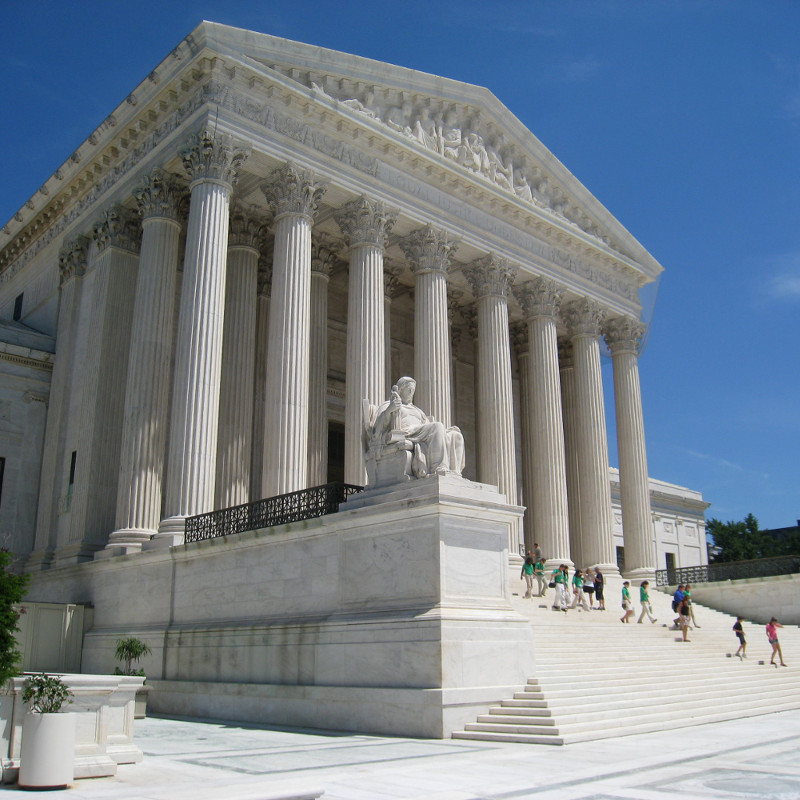
As the 2025 Supreme Court Term begins, the Justices face a number of critically important cases, from criminal law to election procedure and beyond. This post previews key cases that will be argued in the October Sitting and later in the Term. Stay tuned for additional case Previews and Responses as the Term progresses.
Table of Contents
Berk v. Choy
No. 24-440, 3d Cir. (Argument Oct. 6, 2025)
Preview by Andrew M. Boyer, Member
In Berk v. Choy, No. 24-440, the Supreme Court will decide whether a state law that requires a plaintiff’s complaint to include an expert affidavit, or what is often referred to as an “affidavit of merit,” to move forward may be applied in federal courts sitting in diversity. The Court will consider whether such laws violate the Federal Rules of Civil Procedure (“FRCP”), and thus may not be enforced in federal court, or whether such laws express a substantive state right that does not conflict with the FRCP or the Rules Enabling Act, 28 U.S.C. § 2072, and thus may be enforced in federal court.
The case arises from Petitioner Harold Berk, of Pennsylvania, who filed a medical malpractice suit in Delaware Federal District Court against the doctor and two hospitals involved in his ankle surgery. Delaware, like other states in the Third Circuit, has responded to increasing medical malpractice suits and subsequent increases in medical insurance premia by creating new burdens on a plaintiff seeking to file suit. Relevantly to this case, the statute requires that “No health-care negligence lawsuit shall be filed in this State unless the complaint is accompanied by” a qualified expert’s affidavit stating “that there are reasonable grounds to believe that the applicable standard of care was breached by the named defendant or defendants and that the breach was a proximate cause” of the plaintiff’s alleged injuries. Del. Code Ann. tit. 18 § 6853(a)(1), (c). It continues to state that if “the required affidavit does not accompany the complaint . . . then the Prothonotary or clerk of the court shall refuse to file the complaint and it shall not be docketed with the court.” Id. The Petitioner having failed to produce an affidavit of merit, the District Court applied the Delaware statute and dismissed the complaint. No. 22-1506, 2023 WL 2770573 (D. Del. Apr. 4, 2023). The Third Circuit affirmed, citing previous precedent arising under similar laws in Pennsylvania and New Jersey. No. 23-1620, 2024 WL 3534482 (3d Cir. July 25, 2024); see Liggon-Redding v. Est. of Sugarman, 659 F.3d 258, 262–64 (3d Cir. 2011) (Pennsylvania); Nuveen v. Mun. Tr. ex rel Nuveen High Yield Mun. Bond Fund v. Withrum Smith Brown, P.C., 692 F.3d 283, 302 (3d Cir. 2012) (New Jersey). In those cases, as here, the Third Circuit found the affidavit of merit statute did not conflict with the FRCP and the rule was a substantive state rule under Erie, and therefore that it is applicable in federal court.
Petitioner argues, however, that the affidavit of merit requirement does conflict with many of the FRCP and that it cannot apply in federal courts. First, Petitioner contends that the Delaware statute chiefly conflicts with Rules 8 and 9 because it alters the exclusively defined requirements of a pleading in normal and special circumstances in federal court. Brief for Pet. at 13–23. Second, Petitioner argues that Delaware altered the timing and substantive mechanism for how a federal court considers the sufficiency of a claim under Rule 12. Id. at 23–24. Third, Petitioner argues that the affidavit of merit conflicts with Rule 11, which requires an attorney’s attestation of merit. Id. at 24–25. Fourth, Petitioner argues that the law imposes requirements on expert disclosures in conflict with Rules 26 and 37, which stipulate when litigants must file expert opinions and the consequences for failing to adhere to those requirements. Id. at 25–27. According to Petitioner, where the Federal Rules so conflict with a state law, “it is not the substantive or procedural nature or purpose of the affected state law that matters, but the substantive or procedural nature of the Federal Rule.” Shady Grove Orthopedic Associates, P.A. v. Allstate Ins. Co., 559 U.S. 393, 410 (2010). Given that so many of the requirements of the statute directly implicate the complaint stage of litigation, the Petitioner argues that the purpose of the Federal Rules in establishing a notice pleading system with clear timelines for litigation clearly conflicts. Brief for Pet. at 27–29. Whether by acting as a threshold prohibition to docketing a case, by altering the timing and sufficiency of evidentiary productions, or by holding itself out to alter explicitly procedural aspects of filing a case, Petitioner argues that Delaware’s law cannot coexist with the Federal Rules. Accordingly, the federal courts need not apply the law when sitting in diversity.
In contrast, the Respondent doctor and hospital argue that the Delaware law does not actually conflict with any Federal Rule, and that furthermore, the statute implicates substantive choices in Delaware law, which federal courts must respect under Erie. Respondents first raise a textual argument based on Rule 11, which provides that “[u]nless a rule or statute specifically states otherwise, a pleading need not be verified or accompanied by an affidavit.” Fed. R. Civ. P. 11(a); Brief for Respondent Beebe Medical Center, Inc, at 16–21. Accordingly, they claim that the Federal Rules specifically allow for the affidavit of merit required by the Delaware statute. Brief for Respondent Beebe Medical Center, Inc, at 16–21. Furthermore, Respondents argue that the Court should read the statute narrowly to avoid a conflict with the Rules, as called for in many cases in the Erie line. Id. at 22. Because the statute allows for a good cause exception to filing the affidavit of merit with the complaint—an exception that Petitioner utilized in the case at bar—Respondents argue that the state law does not conflict with the timing or initiation standards in Rules 3, 8, or 9. Id. at 23–28. Moreover, Respondents disclaim Petitioner’s exclusive reading of Rule 11, apart the savings clause in the text, and instead focus on the affidavit’s operation as a separate filing which does not alter or conflict with the attorney of record attestation to the complaint itself. Id. 28–29. The Defendants also highlight that federal courts dismiss cases in accordance with state laws that require plaintiffs to post a bond or designate an agent because those requirements operate apart from a complaint’s sufficiency as a matter of Rule 12(b). Id. at 29–31; see Cohen v. Beneficial Indus. Loan Corp., 337 U.S. 541, 557 (1949) (posting bond); Woods v. Interstate Realty Co., 337 U.S. 535, 536 (1949) (designating an agent). Finally, the doctor and hospital rely on the fact that the statute exempts the affidavit from discovery to assert it does not affect the timing, nature, or consequences of expert testimony such that it could not conflict with Rules 26 or 37. Id. at 31–32.
Although civil procedure cases tend not to generate blockbuster news coverage or strident Court opinions, see e.g., Royal Canin U.S.A., Inc. v. Wullschleger, 604 U.S. 22 (2025) (deciding 9–0 that cases where all federal questions are dismissed after removal do not have supplemental jurisdiction under 28 U.S.C. § 1369), Berk v. Choy may yet provide an interesting answer to several questions. For one, it will resolve a current circuit split between the Third and Tenth Circuits, which apply state law affidavits of merit in federal court, and five others that do not. Pet. App. Cert. at 18. Perhaps more importantly, it may continue to elucidate the Court’s increasingly formalist approach to questions before it, if it follows Justice Scalia’s broader preemptive posture in Shady Grove and the four-Justice Gasperini dissent. Indeed, there has not been so clear of an Erie question teed up for the Court since Shady Grove over fifteen years ago. After more formalist approaches to causes of action in CASA, Medina, and on the interim orders docket throughout the summer, this case might provide the Court another opportunity to foreshadow the Court’s direction in the coming years.
Chiles v. Salazar
No. 24-539, 10th Cir. (Argument Oct. 7, 2025)
Preview by Jacob Outwin, Managing Editor
In Chiles v. Salazar, the Court will address whether a Colorado law prohibiting state-licensed mental healthcare providers from engaging in “conversion therapy” with minor patients violates providers’ right to free speech. See Colo. Rev. Stat. § 12-245-224(1)(t)(V). Colorado law defines conversion therapy as “any practice or treatment . . . that attempts or purports to change an individual’s sexual orientation or gender identity.” Id. § 12-245-202(3.5)(a). The law explicitly exempts from its definition of conversion therapy practices that promote “[a]cceptance, support, and understanding for the facilitation of an individual’s coping, social support, and identity exploration and development.” Id. § 12-245-202(3.5)(b)(I).
Petitioner, Kaley Chiles, is a licensed counselor in Colorado who has provided “faith-informed counseling” to minor clients that sought to “reduce or eliminate unwanted sexual attractions, change sexual behaviors, or grow in the experience of harmony with [their] physical body.” Brief for Petitioner at 5. She brought this case after the passage of the law caused her to stop offering these services for fear of losing her license. Id. at 18. She argues that the Colorado law amounts to impermissible viewpoint discrimination under the Free Speech Clause of the First Amendment. Id. at 26. Both the district court and the Tenth Circuit, however, rejected this claim, agreeing with Colorado that the law was a permissible exercise of states’ power to regulate professional conduct. Id. at 19–20. In reviewing the lower courts’ decisions, the Supreme Court will need to decide whether the Colorado law regulates speech as such, and to what extent, to determine the appropriate level of scrutiny.
Petitioner argues that because she practices counseling purely through talk therapy, her interactions with patients constitute speech that is protected with the full force of the First Amendment. See id. at 27–28. Because these interactions occur entirely through speech, she further argues that the Colorado law does not have a merely incidental burden on her speech, but that it instead directly burdens her speech because her counseling practice does not involve conduct at all but would still be within the reach of the law. See id. at 28, 32. Accordingly, petitioner contends that the law singles out and proscribes only speech that encourages minors to change their sexual orientation or gender identity—while permitting speech that affirms a minor’s sexual orientation or gender identity—constituting content-based and viewpoint discrimination subject to strict scrutiny, which it fails. See id. at 38.
Colorado, however, contends, that the law is a valid exercise of the State’s authority to regulate and prohibit healthcare treatment that falls outside of accepted standards of care. See Brief for Respondents at 17–28. According to Colorado, states have long engaged in the regulation of healthcare treatments, so the First Amendment does not bar a state from doing so simply because a particular form of treatment involves words. See id. at 28–36. The State argues that while strict scrutiny should not apply—noting that the regulation of substandard healthcare resembles regulation of false or misleading commercial speech afforded only the protection of intermediate scrutiny—Colorado’s law nevertheless survives any level of scrutiny because ensuring minors receive safe mental healthcare is a compelling interest that the law is narrowly tailored to achieve through its proscription of a specific form of dangerous treatment. See id. at 42–52. Notably, Colorado also suggests that Petitioner has not even alleged a desire to engage in prohibited conduct under the statute because it only prevents therapists from engaging in treatment with the intent to change a minor’s sexual orientation or gender identity, and Petitioner has not characterized her practice as such. See id at 52.
The Supreme Court’s decision in this case will address a disagreement about conversion therapy bans and the right to free speech that has been developing within the courts of appeals for over a decade. See Pickup v. Brown, 740 F.3d 1208 (9th Cir. 2014). The Tenth Circuit here aligned itself with the Ninth and Third Circuits in upholding such a ban, while the Eleventh Circuit remains the only court of appeals to strike down such a ban on free speech grounds. See Tingley v. Ferguson, 47 F.4th 1055 (9th Cir. 2022); King v. Governor of New Jersey, 767 F.3d 216 (3d Cir. 2014); Otto v. City of Boca Raton, 981 F.3d 854 (11th Cir. 2020). Beyond conversion therapy bans, the Court’s decision has the potential to disrupt state regulation of the mental healthcare profession which is often carried out in the form of speech. See Brief of Health Law Scholars as Amici Curiae in Support of Respondents at 19. The case is one of the first the Court will hear this Term, with oral arguments set for October 7, 2025.
Bost v. Illinois State Board of Elections
No. 24-568, 7th Cir. (Argument Oct. 8, 2025)
Preview by Elya Nassaj, Associate
In Bost v. Illinois State Board of Elections, the Supreme Court will decide whether federal candidates have standing under Article III to challenge state election laws that permit the counting of mail-in ballots received after the federally mandated Election Day. The Petitioners—Congressman Michael Bost and two Republican Presidential Elector nominees—argue that Illinois’s rule allowing ballots postmarked by Election Day but received up to fourteen days later undermines federal statutes fixing a uniform Election Day and directly injures their campaigns. Petitioner’s Brief at 1–3.
Petitioners contend that this regime conflicts with federal law and burdens their candidacies by prolonging campaigns, forcing them to spend more money on get-out-the-vote efforts and election monitoring, and exposing them to uncertainty about electoral outcomes. Petitioner’s Brief at 23–34. As a result, the law inflicts both competitive and “pocketbook” injuries against their campaigns. Id. Petitioner argues that they have standing to challenge this law since candidates have strong personal stakes in ensuring that the final vote is accurately tallied and the election is lawfully conducted. Id. at 2–3, 17–18.
Respondent argues that Petitioners lack Article III standing for three main reasons. First, the state contends that Petitioners waived any claim that Illinois’s ballot-receipt deadline increases their likelihood of losing an election, leaving no basis to allege a concrete electoral injury. Respondent’s Brief at 16, 24–31. Second, Respondent maintains that Petitioners’ claimed financial harms—such as keeping campaign staff employed for an extended period—are self-inflicted choices rather than injuries caused by state law. Id. at 39–50. Third, the state insists that any broader interest in accurate vote counts is a generalized grievance shared equally by all voters and candidates, which cannot support standing. Id. at 17–24.
The Court’s ruling could have sweeping implications for election law and could reshape how states conduct their vote counting processes. If the Court sides with Petitioners, it would expand candidate standing, enabling more pre-election challenges to state voting rules. That outcome could cast doubt on practices across dozens of states like Illinois that count ballots received after Election Day. On the other hand, affirming the Seventh Circuit would reinforce strict limits on Article III standing and preserve state flexibility to accommodate absentee voting. Such a ruling would likely emphasize that candidates, like any other plaintiffs, must show individualized, nonspeculative, and traceable harm, for which a candidate’s loss of potential electoral prospects and pocketbook losses do not qualify. Nevertheless, by clarifying whether candidates themselves may invoke Article III to enforce federal election statutes, the Court’s decision could reshape the contours of election litigation for years to come.
United States Postal Service v. Konan
No. 24-351, 5th Cir. (Argument Oct. 8, 2025)
Preview by Anna Capria, Associate
In United States Postal Service v. Konan, the Supreme Court will address whether an intentional refusal to deliver mail is covered by the postal-matter exception to the Federal Tort Claims Act (“FTCA”). The FTCA postal exception shields the U.S. Postal Service (“USPS”) from liability for the “loss, miscarriage, or negligent transmission” of mail. 28 U.S.C. § 2680(b). The Fifth Circuit’s decision created a significant circuit split as to whether the exception applies to claims for intentional acts. 96 F.4th 799, 804 (5th Cir. 2024). The issue is now before the Supreme Court, including the questions of whether the FTCA immunizes the USPS from lawsuits when mail is intentionally withheld and what the broader consequences are for government accountability and civil rights. Petition for Cert. at 1–3.
The USPS argues that the FTCA applies to intentional acts like deliberate nondelivery because such acts constitute “loss” or “miscarriage” of mail within the meaning of the exception. Id. at 5–10. It asserts that interpreting the law otherwise would enable any aggrieved party to bypass USPS immunity by simply alleging intent, potentially triggering a flood of expensive lawsuits and expansive discovery demands. Id. at 7–8. Citing the Supreme Court precedent in Dolan v. United State Postal Service, 546 U.S. 481, 484 (2006), which explained the “general rule” that the exception applies when “mail either fails to arrive at all or arrives late, in damaged condition, or at the wrong address,” the government asserts that immunity should cover all mail delivery failures, including intentional nondelivery. Petition for Cert. at 3.
In contrast, Konan contends that the FTCA postal exception only covers unintentional acts, rather than purposeful refusals to deliver mail. Brief for Respondent at 7–8. Konan points out that the statutory terms “loss” and “miscarriage” contemplate unintentional acts. Id. Konan warns that denying remedies for intentional wrongdoing effectively grants government employees immunity to act with impunity, leaving harmed individuals without recourse, especially in cases involving discriminatory or malicious conduct. Brief in Opposition at 19–21.
Should the Supreme Court side with Konan, the USPS could face increased litigation for intentional nondelivery or misconduct, which may lead to greater judicial scrutiny and possible damages awards. Kelsey Dallas, How a Mail Delivery Dispute Made It to the Supreme Court, SCOTUSblog (Oct. 3, 2025), https://www.scotusblog.com/2025/10/how-a-mail-delivery-dispute-made-it-to-the-supreme-court/, [https://perma.cc/N9VJ-N775]. Conversely, a ruling favoring the government would reinforce existing immunity, potentially reducing accountability for willful or discriminatory acts, a result critics argue could insulate postal workers from civil liability even in clear cases of bias. Petition for Cert. at 9; Konan, 96 F.4th at 803–04. The ruling might reshape the balance between government immunity and individual rights in discrimination and tort claims involving federal workers. See Dallas, supra. Additionally, upholding the postal exception as interpreted by the Fifth Circuit could impose operational burdens and legal risks on the USPS, possibly prompting reforms to prevent intentional nondelivery claims. Petition for Cert. at 11–13. The Supreme Court’s ruling is expected to have wide-reaching implications for tort liability and government accountability.
Bowe v. United States
No. 24-5438, 11th Cir. (Argument Oct. 14, 2025)
Preview by Aidan Keaveney, Member
Consider two prisoners convicted of the same crime––a crime which has two sufficient bases for conviction. Both of our prisoners’ convictions were supported on both grounds. Now suppose the Supreme Court strikes down one of those grounds. The first prisoner’s lawyer jumps the gun and files a post-conviction relief claim, believing she may be able to get her client out of prison. That motion will be denied, because the Supreme Court only struck down half of the law; the prisoner’s violation of the remaining half was a sufficient ground for conviction. But then, a few years later, the Supreme Court strikes down the other half of the law, rendering both grounds for the prisoners’ convictions completely invalid. The second prisoner’s lawyer (probably a GW Law alumna) now files for post-conviction relief on behalf of her client and succeeds. But what about the first prisoner? Can the first prisoner’s lawyer file another post-conviction relief claim? Or will the first prisoner be stuck in prison, notwithstanding the now-unconstitutional basis for her conviction? And, as I am sure many readers want to know, will the first prisoner’s lawyer be subject to a malpractice suit?
It turns out, the answer may depend on whether the prisoner was convicted of a state crime or a federal crime. Under 28 U.S.C. § 2244(b), a state prisoner who has once petitioned for a writ habeas corpus can never file another petition making the same claim for a second time, though she can sometimes make a new claim. However, 28 U.S.C. § 2255(h) seemingly states that regardless of whether the movant’s claim was made in a previous motion to vacate a conviction, it can be brought in a second or successive motion provided one of the statutory conditions is met. In other words, the text of these statutes suggests that state prisoners may be able to bring new claims but not old claims in their successive habeas petition; federal prisoners may be able to bring any claims in their successive motion to vacate.
Except, 28 U.S.C. § 2255(h) starts out by saying the successive motion must be certified “as provided by [§] 2244.” The question then arises: Does § 2255(h) incorporate the § 2244(b) prohibition on repeat claims? Six courts of appeals have said yes. See Pet’r’s Br. at 16. This reading results in equal treatment for state and federal prisoners, but it is perhaps less textually plausible. Id. at 20–22. The three minority courts of appeals see differential treatment of state and federal prisoners as an acceptable manifestation of federalism: Federal courts should show greater reluctance to vacate state sentences than federal sentences. Id. at 26–27.
In this case, Petitioner Michael Bowe appeals from an order of the Eleventh Circuit dismissing his claim under the majority position and asks the Supreme Court to resolve the circuit split. Id. at 11. Unusually, Bowe and the government both agree that the minority circuits have the better argument. See id. at 16; Gov’t’s Br. at 43. They disagree, however, about whether the Supreme Court has the power to resolve the circuit split. See Pet’r’s Br. at 28; Gov’t’s Br. at 21.
This question, like the first, concerns the scope of the “as provided by [§] 2244” language in § 2255(h). That language indisputably incorporates the procedural requirements of § 2244(b)(3)(A)–(D); it would seem to follow that § 2244(b)(3)(E) is incorporated as well. Except, § 2244(b)(3)(E) denies the Supreme Court jurisdiction to review orders granting or denying requests by state prisoners to make successive habeas petitions. If § 2255(h) incorporates § 2244(b)(3)(E), then the Supreme Court lacks jurisdiction to hear such orders with respect to federal prisoners as well. Since Bowe arguably appeals from such an order, see Gov’t’s Br. at 34–35, this position would mean the Supreme Court could not decide this case and thus could not resolve the circuit split, see Pet’r’s Br. at 16.
Bowe’s primary argument is that the Supreme Court should, as it is wont to do, construe this restriction of its jurisdiction narrowly. Pet’r’s Br. at 28. Resolving circuit splits is a core function of the Supreme Court, because uniform interpretation of federal law is considered important. See id. at 44–45. For Congress to strip the Supreme Court of that function would arguably infringe on the separation of powers. Id. Thus, even if the United States’ position is more textually plausible, the Supreme Court may be hesitant to accept it without clearer evidence of congressional intent to that effect. Id.
Still, recognizing the textual hurdles to reaching his position, Bowe offers a potential off-ramp which would at least give the Court jurisdiction over this case. Id. at 35. Bowe argues that he appeals from a dismissal of his request to make a successive motion to vacate based on lack of jurisdiction, not a denial of his request on the merits. Id. at 35–36. Therefore, it could be argued that even if the Supreme Court may lack jurisdiction over the order Bowe sought, it has jurisdiction over the order the Eleventh Circuit issued.
In summary, while the parties appear to agree about how the underlying circuit split should be resolved, they disagree about whether the Court has the power to resolve it. The Court’s decision may depend on how it balances its own ability to resolve circuit splits with avoiding anomalous textual interpretations.
Although we can expect an opinion rife with silcrows and triple-nested parentheses, we should not forget the real-world consequences of the Court’s decision in this case. A ruling for the government could mean that some prisoners who were convicted under now-unconstitutional statutes will have to remain in prison. Such a ruling would also disincentivize seeking post-conviction relief in close cases out of fear that prisoners will be barred from making the same claim on stronger grounds after future legal developments. On the other hand, a ruling for Bowe could result in a flood of post-conviction relief claims every time a prisoner can make a cognizable claim that the basis of their conviction has been invalidated.
In other words, don’t let the silcrows and triple-nested parentheses fool you: This case is the next in the long line of debates over administrability and access to justice.
Louisiana v. Callais
No. 24-109, W.D. La. (Argument Oct. 15, 2025)
Preview by Callie Stevens, Articles Editor
In Louisiana v. Callais, consolidated with Robinson v. Callais, the Court will consider whether Louisiana’s proposed congressional voting districts are an unconstitutional racial gerrymander. Brief for Petitioner Louisiana at i; Brief for Petitioners Robinson Plaintiffs at i. The Court already heard argument once for this case, on March 24, 2025, before moving it to the calendar for rehearing this term. Louisiana v. Callais, 606 U.S. ____, 145 S. Ct. 2608 (2025) (mem.) (order for reargument); Transcript of Oral Argument, Louisiana v. Callais, 606 U.S. ____ (2025). Before the upcoming arguments, the Court asked for supplemental briefing on whether S.B. 8 violates the Fourteenth and Fifteenth Amendments of the Constitution. Louisiana v. Callais, 606 U.S. ____, 2025 WL 2180226 (2025) (mem.).
After Louisiana’s state legislature passed H.B. 1, creating new congressional voting districts for Louisiana, two groups challenged the map under Section 2 of the Voting Rights Act in Robinson v. Ardoin, 605 F. Supp. 3d 759 (M.D. La. 2022). One was the “Robinson Plaintiffs,” a group of Black voters and civil rights groups. See Robinson v. Ardoin, 86 F.4th 574 (5th Cir. 2023). The district court found that two majority-Black districts were feasible and would not violate the VRA; the court required Louisiana to draw a new map. Brief for Petitioner Louisiana at 6. The Louisiana legislature considered several maps, including S.B. 4, a similar map to the one the Robinson Plaintiffs suggested. Id. at 12–15. The legislature passed S.B. 8 instead, a different map that included two majority-Black districts while being the “best incumbent-protecting solution.” Id. at 15, 18.
Louisiana was then sued by a group of “non-African American voters” who alleged the S.B. 8 map was an unconstitutional racial gerrymander. Id. at 19, 20. The district court found the primary reason for creating District 6 was race which therefore failed a strict scrutiny analysis, leading to the court enjoining the use of S.B. 8 in future elections. Id. at 19–20. Louisiana’s appeal was denied. Id. Louisiana sought a stay of the injunction pending appeal, and the Supreme Court granted certiorari. Id.
Last term, the Court heard argument on whether District 6 is a racial gerrymander. Transcript of Oral Argument, Louisiana v. Callais, 606 U.S. ____ (2025). Louisiana argued the Court should reverse for lack of standing because the appellees alleged no specific harm and are not members of the group that was affected. Brief for Petitioner Louisiana at 23–25. It argued on the merits that the district court incorrectly held that the creation of District 6, a majority-Black district, “automatically established racial predominance.” Id. at 33; Transcript of Oral Argument at 5. Any focus on race was therefore a result of the Robinson court’s requirements. Brief for Petitioner Louisiana at 34–38. Louisiana argued the lack of focus on race is shown by the legislature’s focus on preventing certain congressmen from being moved to districts where they would be unlikely to win. Id. at 38. The Robinson Plaintiffs largely argued along similar lines. Brief for Petitioners Robinson Plaintiffs at 21–24. They challenged the lack of “breathing room” afforded to the legislature in drawing maps that complied with Section 2 while still affording deviations for policy goals. Id. at 45–47. Additionally, they argued that the lower court misapplied the Gingles standards, which give legislatures a “strong basis in evidence” that majority-minority districts are needed if preconditions are established. Id. at 39–41.
The appellees argued that the S.B. 8 map was created with the predominant consideration of race, relying on the legislature’s statements made when considering S.B. 8 and the shape of District 6. Brief for Appellees at 22, 24–27. They argued that for a map to succeed under strict scrutiny, a state must have a compelling interest and be narrowly tailored. Id. at 34–38. Here, compliance with Section 2 was not compelling because it is no longer necessary given integration. Id. at 38. Appellees challenged that Section 2 required a second majority-Black district under the Gingles standards because there were not joint interests between the Black communities in District 6. Id. at 42–44.
The upcoming arguments will focus on whether S.B. 8 violates the Fourteenth and Fifteenth Amendments. Louisiana v. Callais, 606 U.S. ____, 2025 WL 2180226 (2025) (mem.).
Louisiana “decline[d] to defend S.B. 8 on [the] question presented” and argued that it is a constitutional violation because race-based redistricting in line with Section 2 violates the Equal Protection Clause. Supplemental Brief for Petitioner Louisiana at 1–2. The state also argued that Section 2 conflicts with the Fifteenth Amendment, and racial classifications done to comply with Section 2 should not be permissible as they fail strict scrutiny. Id. at 17–24, 33–37. Additionally, Louisiana argued that there is no end to race-based considerations under Section 2, so it conflicts with Students for Fair Admission. Id. at 24–26.
The Robinson Plaintiffs sought to uphold Section 2, arguing that it supports individuals’ rights to vote and avoid discrimination. Supplemental Brief for Petitioners Robinson Plaintiffs at 1–7. They argued that procedurally, the appellees’ challenge should fail because it was raised too late in the litigation. Id. at 37–40. Substantively, they support the continuing need for Section 2 because of ongoing racial discrimination and the limited scope of Section 2. Id. at 33–37.
Appellees have argued that the Fourteenth and Fifteenth Amendments prevent racial considerations and discrimination, including in districting. Supplemental Brief for Appellees at 5–8. Following from this, Section 2 is no longer justified as the burdens it places on legislatures and the public outweighs the benefits it provides. Id. at 8–9, 13–16. Additionally, Appellees argue that under a strict scrutiny test, S.B. 8 and by extension Section 2 fail because they cannot show current pervasive discrimination and have no logical end. Id. at 18–30, 32–34.
This case might represent the Court’s interest in overturning Section 2 of the Voting Rights Act, especially given that the Court has ordered additional oral arguments (a rare occurrence) and asked for supplemental briefing. Louisiana v. Callais, 606 U.S. ____ at 3–6 (2025) (order for reargument); Louisiana v. Callais, 606 U.S. ____ (2025) (ordering supplemental briefing).
Case v. Montana
No. 24-624, Mont. (Argument Oct. 15, 2025)
Preview by Emma Bjeldanes, Notes Editor
In Case v. Montana, the Court will consider whether the emergency-aid exception to the Fourth Amendment permits law enforcement to enter a home without a search warrant based on less than probable cause that an emergency is occurring. See Petition for Certiorari at i.
The Fourth Amendment protects individuals against “unreasonable searches or seizures” by the government. U.S. Const. amend. IV. Although a warrant is generally required for a search to be reasonable, the Court has recognized certain exceptions where a warrantless search is allowed. Brief of Petitioner at 1. One such circumstance is when law enforcement officers enter a home in response to an emergency. Id. at 15. For this “emergency-aid” exception to apply, officers must have “an objectively reasonable basis for believing that an occupant is seriously injured or imminently threatened with such [an] injury.” Brigham City v. Stuart, 547 U.S. 398, 400 (2006). Circuits and state high courts are divided on whether this “objectively reasonable basis” standard requires that officers have probable cause of an emergency or some lesser standard of suspicion. See Petition for Certiorari at 1.
In 2021, Trevor Case’s ex-girlfriend called police after he threatened suicide. Petitioner’s Brief at 6. She reported that he was intoxicated, mentioned a note, and that she heard sounds resembling a gun being cocked and fired. See id. Officers entered Case’s home without a warrant, concerned that his life was in danger. See id. at 7. After a confrontation with police in the house, Case was convicted of felony assault of an officer. See id. at 10. He moved to suppress the evidence obtained from the officers’ warrantless entry, but the motion was denied. See id. at 10–11. On appeal, the Montana Supreme Court affirmed the trial court’s denial of suppression. Id. at 12. The majority held that probable cause was not required under the emergency-aid exception, and officers had met the distinct reasonable basis requirement articulated by the Supreme Court in Brigham City. See id.
Petitioner Case argues that courts have diluted the reasonable basis test to require less than probable cause, enabling police to make unconstitutional entries into homes without a warrant. See id. at 14. Case says that all exigent circumstances justifying warrantless entry must be supported by probable cause. See id. at 16. He contends that had the Montana court applied this correct standard, it would have found that the officers lacked probable cause to enter, and the evidence would have been suppressed. See id. at 18.
Montana responds that in practice the reasonable basis test is as rigorous as probable cause, even if phrased differently. See Brief of Respondent at 13. Although some courts have said the emergency-aid exception imposes a more lenient standard, in application those courts still require the same level of justified suspicion as for other exigent circumstances. Brief in Opposition to Petition for Certiorari at 1–2. Montana argues that the concept of “probable cause” is tied to suspicion of criminal activity, while “reasonable basis” properly frames the inquiry as a determination of whether there is a life-threatening risk or injury. See Brief of Respondent at 28. Respondent maintains that the current test meets the requirements of the Fourth Amendment, and there is no need to use the phrase “probable cause” with respect to the emergency-aid exception. See id. at 13.
The Court’s decision in this case will determine if the emergency-aid exception allows law enforcement to enter a home on less suspicion than other exigent circumstances. The ruling will shape how much discretion police can exercise in responding to potential emergencies. Oral argument is set to take place on October 15, 2025.
Urias-Orellana v. Bondi
No. 24-777, 1st Cir. (Argument TBD)
Preview by Natalie More, Member
In Urias-Orellana v. Bondi, the Supreme Court will decide whether federal courts must defer to a Board of Immigration Appeals (“BIA”) determination that a given set of undisputed facts does not amount to “persecution” under the Immigration and Nationality Act (“INA”), 8 U.S.C. § 1101(a)(42), or if courts can instead review that ultimate characterization de novo. The outcome matters enormously for asylum adjudication and comes as the Court re-examines the reach of judicial deference more broadly.
The INA permits asylum for noncitizens on American soil if they qualify as “refugees.” 8 U.S.C. § 1158(b)(1)(A). A refugee is an individual who cannot return home because of “a well-founded fear of persecution on account of race, religion, nationality, membership in a particular social group, or political opinion.” Id. § 1101(a)(42). Noncitizens are also presumptively eligible for asylum if they have “suffered persecution in the past.” 8 C.F.R. § 1208.13(b)(1). Courts reviewing asylum petitions must ordinarily accept the BIA’s factual findings unless “any reasonable adjudicator would be compelled to conclude the contrary.” Petitioner’s Brief at 14 (quoting Gonzalez-Arevalo v. Garland, 112 F.4th 1, 8 (1st Cir. 2024)).
Douglas Humberto Urias-Orellana, his wife, and their young child fled El Salvador after years of violence tied to a local hitman who had shot two of Urias-Orellana’s half-brothers and threatened to kill the rest of the family. Id. at 9–10. Masked men demanded money and threatened to kill Urias-Orellana multiple times, which ultimately escalated into a physical assault in 2020. Id. Although the family relocated several times within El Salvador, they were repeatedly found by their assailants before fleeing to the United States in 2021. Id. at 11.
The Immigration Judge (“IJ”) credited Urias-Orellana’s testimony but denied asylum, reasoning that the threats and a single, nonhospitalizing assault did not amount to past persecution and that relocating within El Salvador offered a reasonable safeguard against future persecution. Petitioner’s Brief at 11–12; Respondent’s Brief at 6–8. The IJ likewise rejected Urias-Orellana’s claim for protection under the Convention Against Torture (“CAT”) since he had not reported the threats to local authorities or shown that doing so would be futile. Respondent’s Brief at 5 & n.1. The BIA adopted the IJ’s reasoning and affirmed. Petitioner’s Brief at 46. The First Circuit denied Urias-Orellana’s petition for review. Urias-Orellana v. Garland, 121 F.4th 327, 335 (1st Cir. 2024).
Petitioners argue that applying the statutory standard of “persecution” to established facts is a mixed question of law and fact that falls within § 1252(a)(2)(D)’s carve-out for “questions of law,” not a “finding of fact” subject to deference under § 1252(b)(4)(B). Petitioner’s Brief at 18–19. Relying on Wilkinson and Guerrero-Lasprilla, Petitioners stress that applying law to fact is not a factual inquiry. They also invoke Loper Bright to emphasize courts’ duty to “say what the law is,” warning that deferring to the BIA on this ultimate determination insulates legal judgments from meaningful review and risks inconsistent, politicized outcomes. See id. at 49; Reply Brief for Petitioner at 5–6 (quoting Marbury v. Madison, 5 U.S. (1 Cranch) 137, 177 (1803)).
The government maintains the BIA’s persecution determinations are “primarily factual” mixed questions, turning on degrees of harm, context, and credibility, that courts must review only for substantial evidence under 8 U.S.C. § 1252(b)(4). Respondent’s Brief at 9–15. In its view, such deference respects the BIA’s expertise in assessing the severity of harm in the asylum context and avoids inviting courts to second-guess fact-intensive judgments. Id. According to the government, requiring de novo judicial review would undermine the BIA’s role and invite inconsistent outcomes across the federal courts. Id.
The case highlights a sharp circuit split: The First, Sixth, Seventh, and Tenth Circuits treat persecution determinations as factual findings subject to deferential review, while the Second, Third, Fourth, Fifth, Eighth, Ninth, and Eleventh Circuits apply de novo review. Petitioner’s Reply at 1–3; Respondent’s Brief at 15–18. Several courts have issued inconsistent rulings within their own circuits, and judges across the country have urged the Supreme Court to resolve the disarray. Respondent’s Brief at 16.
A ruling for Urias-Orellana could expand judicial oversight of asylum claims, promoting uniformity across circuits and limiting agency discretion. A ruling for the government would reinforce the BIA’s primacy and preserve deferential review of fact-heavy records. Beyond immigration, the case echoes the Court’s retreat from Chevron deference, raising the broader question of who should have the final word when applying statutory standards.
The Hain Celestial Group, Inc. v. Palmquist
No. 24-724, 5th Cir. (Argument Nov. 4, 2025)
Preview by Nam Lam, Member
In The Hain Celestial Group, Inc. v. Palmquist, the Supreme Court will address whether a district court’s final judgment as to completely diverse parties should be vacated when the earlier dismissal of a nondiverse party at the time of removal was found erroneous on appeal. Petitioners are Hain Celestial Group, Inc., a citizen of Delaware and New York, and Whole Foods Market Rocky Mountain/Southwest, L.P., a citizen of Texas. Brief of Petitioners at 3. Respondents are Sarah Palmquist, Grant Palmquist, and their son, all of whom are citizens of Texas. Id.
In 2021, a congressional staff report found “elevated levels of toxic heavy metals” in Hain’s baby food products. Brief for Respondents at 5. Respondents purchased Hain’s products from Whole Foods for their son until his health deteriorated, and he was later diagnosed with an autism spectrum disorder allegedly linked to “high levels of toxic metals appearing in [his] blood tests.” Id. at 5–6. Respondents sued Petitioners in Texas state court, asserting negligence and breach of warranty claims. Id. at 7.
Petitioners removed the case to the federal district court under diversity jurisdiction, arguing that Whole Foods was “fraudulently joined” because Texas law generally shields sellers from liability for products they did not manufacture. Brief of Petitioners at 4. The district court agreed, dismissing Whole Foods from the case, and later entered a judgment as a matter of law for Hain after finding insufficient evidence that Hain’s products caused the Respondents’ son’s disorder. Id. at 5–6. On appeal, the Fifth Circuit vacated the judgment and ordered the case to be remanded to the state court, holding that there was a “defect in subject-matter jurisdiction at the time of judgment” because the dismissal of Whole Foods was erroneous. Brief for Respondents at 10.
Petitioners argue that no jurisdictional flaw existed because there was complete diversity when the district court entered its final judgment. Brief of Petitioners at 12. They rely on Caterpillar, Inc. v. Lewis, where the Court upheld a district court’s final judgment despite erroneous removal because jurisdiction was proper “at the time the judgment [wa]s entered.” Id. at 14 (quoting Caterpillar, Inc. v. Lewis, 519 U.S. 61, 73 (1996) (alteration in original)). Petitioners contend that once Whole Foods was dismissed, complete diversity was satisfied. Id. at 18.
Petitioners also emphasize the importance of “finality, efficiency, and economy” in preserving judgments after a diversity case is tried. Id. at 15 (quoting Caterpillar, 519 U.S. at 75). They argue that vacating the judgment would be a “waste of time and resources . . . forcing the[] parties to begin anew.” Id. at 27 (quoting Newman-Green, Inc. v. Alfonzo-Larrain, 490 U.S. 826, 838 (1989)) (second alteration in original). Instead of restarting the litigation, Petitioners suggest the jurisdictional defect could be resolved by dismissing Whole Foods under Federal Rule of Civil Procedure 21. Id. at 22.
Respondents argue that the Fifth Circuit correctly vacated the final judgment because complete diversity did not exist. Brief for Respondents at 11. They contend that diversity jurisdiction depends on citizenship “at the time of the action brought.” Id. at 30 (quoting Grupo Dataflux v. Atlas Glob. Grp., L.P., 541 U.S. 567, 570 (2004)). With respect to Caterpillar, Respondents argue that it favors their position because the Court held that if “a jurisdictional defect remains uncured, the judgment must be vacated.” Id. at 20 (quoting Caterpillar, 519 U.S. at 77). Unlike in Caterpillar where the nondiverse defendant was properly dismissed because the plaintiff settled its claim with the defendant, Respondents here argue that dismissal was erroneous because they did not ever settle their claims against Whole Foods throughout the litigation. Id. at 20–21; 519 U.S. at 64.
Respondents also oppose Petitioners’ judicial economy argument by stressing that an “uncorrected defiance of a categorical congressional judgment,” such as failing to remand a case due to a jurisdictional defect, cannot be justified just because it is “inefficient” or “wasteful.” Brief for Respondents at 19 (quoting Lexecon Inc. v. Milberg Weiss Bershad Hynes & Lerach, 523 U.S. 26, 42 (1998)). Respondents also add that remanding the case would not be inefficient because discovery from the federal proceedings could be used again in state proceedings. Id. at 34.
Ultimately, the Court’s decision in Palmquist will have a significant impact on the balance between judicial economy and constitutional limits. If the Court sides with Petitioners, it would affirm that complete diversity is based on citizenship at the time of judgment as opposed to at the time of removal, which could promote efficiency at the cost of federalism concerns of infringing on state courts. Alternatively, if the Court sides with Respondents, it would affirm that jurisdiction must exist continuously from the time of filing all the way until judgment, which would protect state jurisdiction but could lead to unnecessary litigation.
Trump v. Slaughter
No. 25-332, D.D.C. (Argument December 2025)
Preview by Maddie Boucher, Online Editor
In Trump v. Slaughter, the Court will determine whether Federal Trade Commission (“FTC”) Commissioner Slaughter’s termination without cause was unconstitutional. In March 2025, Commissioner Slaughter received an email with a message from President Trump indicating her immediate removal from the FTC under his Article II power because “[her] continued service on the FTC is inconsistent with [his] Administration’s priorities.” Slaughter v. Trump, No. 25-cv-909, 2025 WL 1984396, at *2 (D.D.C. July 17, 2025). This removal occurred before her term ended and without any allegations of committing “any inefficiency, neglect of duty, or malfeasance,” a requirement in the Federal Trade Commission Act for terminating a Commissioner. Id. As a result of her termination, Commissioner Slaughter sued President Trump, FTC Chair Ferguson, FTC Commissioner Holyoak, and FTC Executive Director David Robbins under a theory that her removal was illegal and should not be honored. Id. at *3.
The U.S. District Court for the District of Columbia granted Commissioner Slaughter’s motion for summary judgment and ordered her reinstatement because of Supreme Court precedent, specifically its 1935 decision in Humphrey’s Executor v. United States. Id. at *7–15. The district court explained how the Supreme Court unanimously held in Humphrey’s Executor that “the FTC Act’s for-cause removal protections were constitutional” and did not interfere with the President’s power under Article II. Id. at *6. Thus, the district court, honoring this ninety-year-old precedent, granted Commissioner Slaughter’s motion for summary judgment and issued a permanent injunction against her wrongful, without-cause termination. Id. at *20.
After the district court’s decision, President Trump requested a stay from the U.S. Court of Appeals for the District of Columbia Circuit pending the government’s appeal. The court of appeals likewise denied President Trump’s motion for stay because the government is “highly unlikely to succeed on appeal because [the] exact question was already asked and unanimously answered by the Supreme Court adversely to the government’s position 90 years ago in Humphrey’s Executor.” Slaughter v. Trump, No. 25-5261, 2025 WL 2551247, at *2 (D.C. Cir. Sept. 2, 2025). President Trump then filed an application at the Supreme Court to stay the judgment of the U.S. District Court for the District of Columbia and request an administrative stay.
In his application to the Supreme Court, President Trump primarily argued that the Court should disregard the “expansive reading” of Humphrey’s Executor and instead should follow its reasoning for granting stays in Trump v. Wilcox and Trump v. Boyle. Application to Stay the Judgment of the United States District Court for the District of Columbia and Request for Administrative Stay at 2–3. Specifically, in Wilcox and Boyle the Court explained that the President may remove, without cause, “members of agencies that ‘exercise considerable executive power.’” Id. at 27. Applying this rationale, the Court found that the Government was likely to show that members of the National Labor Relations Board, Merit Systems Protection Board, and Consumer Products Safety Commission exercise such executive power that terminating its members without cause is legal. Id. at 3. Here, President Trump argued that Commissioner Slaughter yields similar executive power, so following the Court’s rulings in Wilcox and Boyle, she may also be fired without cause. Id. at 2.
In opposition to the applicants’ request for an administrative stay, Commissioner Slaughter argued that Humphrey’s Executor squarely controls this issue and her termination was illegal. Opposition to Applicant’s Request for an Administrative Stay at 1. Further, Commissioner Slaughter reiterated the D.C. Circuit’s differentiation between her role as FTC Commissioner and the stays granted in Wilcox and Boyle because she is the sole Democratic member on a Commission with three Republicans and thus “returning [her] to her position will [not] result in any meaningful regulatory action opposed by the Commission majority.” Id. at 2.
On September 22, 2025, Chief Justice Roberts granted the Government’s application and stayed the order that returned Commissioner Slaughter to her position, keeping her out of the FTC until the case is formally decided by the Supreme Court. Trump v. Slaughter, Nos. 25A264, 25-332, 2025 WL 2692050 (U.S. Sept. 22, 2025). Arguments are set for December and the questions to be briefed and answered are “(1) [w]hether the statutory removal protections for members of the Federal Trade Commission violate the separation of powers and, if so, whether Humphrey’s Executor v. United States should be overruled” and “(2) [w]hether a federal court may prevent a person’s removal from public office, either through relief at equity or at law.” Id. This case is particularly significant because not only would it overturn ninety-year-old precedent, but it would expand the President’s power to control “independent agencies.” See Josh Gerstein, Supreme Court Allows Trump to Fire FTC Member While Court Mulls Future of Independent Agencies, Politico (Sept. 22, 2025, 4:41 PM), https://www.politico.com/news/2025/09/22/supreme-court-ftc-trump-firing-00575714 [https://perma.cc/DSD5-S3LU].
National Republican Senatorial Committee v. FEC
No. 24-621, 6th Cir. (Argument TBD)
Preview by Molly Kalb, Associate
In National Republican Senatorial Committee v. Federal Election Commission, the Supreme Court will reconsider a major limitation on campaign financing it reviewed in the 2001 case Federal Election Commission v. Colorado Republican Federal Campaign Committee, which continued to allow federal restrictions on coordinated campaign expenditures. These are “special expenditures in connection with the general election campaigns of federal candidates” from either national party committees or state party committees. See Coordinated Party Expenditures, Federal Election Commission, https://www.fec.gov/help-candidates-and-committees/making-disbursements-political-party/coordinated-party-expenditures/ [https://perma.cc/GMV2-MQXX] (emphasis added).
This restriction was first implemented when Congress passed the Federal Election Campaign Act of 1971 to set rules for campaign spending and to give the Federal Election Commission (“FEC”) power to regulate compliance during elections. See Kalvis Golde, In Lawsuit Originally Filed by J.D. Vance, GOP Asks Court to Overrule Limit on Campaign Spending, SCOTUSblog (Mar. 26, 2025), https://www.scotusblog.com/2025/03/in-lawsuit-originally-filed-by-j-d-vance-gop-asks-court-to-overrule-limit-on-campaign-spending/ [https://perma.cc/F9MQ-77VR]. These rules included limitations on coordinated party expenditures, independent expenditures, and individual contributions to campaigns. See id.
Independent expenditures are made “relative to a clearly defined candidate.” See, e.g., Buckley v. Valeo, 424 U.S. 1, 7 (1976) (per curiam). A coordinated party expenditure is different from an independent expenditure because the money is spent in “cooperation, consultation, or concert with the campaign.” See, e.g., Coordinated Expenditures, Phila. Campaign Fin. Res. Ctr., https://sites.google.com/view/cfresources/contributions-to-city-candidates/coordinated-expenditures [https://perma.cc/XR3L-SXV7].
In Buckley v. Valeo, the Supreme Court found the limitations on contributions to be constitutional despite infringing on the First Amendment but struck down limitations on independent expenditures. See Buckley, 424 U.S. at 143. In the per curiam opinion, the Court found the cap on contributions to be a sufficiently tailored limitation that addressed the problem of quid pro quo for large campaign donations, a “narrow aspect of political association where the actuality and potential for corruption have been identified.” Id. at 28.
However, the Justices rejected the same “government interest in preventing corruption and appearance of corruption” argument as insufficient to justify restrictions on independent expenditures. Id. at 45. Given the lack of coordination between the money spent and a candidate’s campaign, the Court found the risk of corruption to be less compelling than the heavy burden on free speech. Id. The per curiam opinion differentiated this from “coordinated expenditures,” finding that if money were spent in coordination with a campaign, it should be “treated as contributions rather than expenditures under the Act.” Id. at 46.
In 2001, the Supreme Court cited Buckley in FEC v. Colorado Republican Federal Campaign Committee to find that “party coordinated spending [is] the functional equivalent of contributions.” See FEC v. Colo. Republican Fed. Campaign Comm., 533 U.S. 431, 447 (2001). Therefore, unlike independent expenditures, the Court held coordinated party expenditures could be limited without violating the First Amendment. Id. at 465. The majority opinion from Justice Souter described the standard of scrutiny for limitations on contributions, including coordinated party expenditures, to be “closely drawn to match . . . [a] sufficiently important government interest in combating political corruption.” Id. at 456 (citation modified). Justice Souter found the plaintiffs’ First Amendment arguments unconvincing and held that the restrictions were necessary to prevent corruption and circumvention of individual contribution limits. Id. at 461.
In 2022, the National Republican Senatorial Committee (“NRSC”), then-Senator J.D. Vance, and former Ohio Representative Steve Chabot filed a lawsuit to strike down the restrictions on coordinated party expenditures as unconstitutional violations of the First Amendment. See NRSC v. FEC, 117 F.4th 389, 391–92 (6th Cir. 2024). The plaintiffs argued that in a modern campaign context, the limitations impermissibly restricted the right to political speech, the laws and facts had changed since 2001, and limitations on coordinated expenditures had resulted in the rise of undemocratic super PACs. See id. at 391.
In answer, the Sixth Circuit found that the Supreme Court decision in FEC v. Colorado Republican Federal Campaign Committee bound lower courts to upholding limitations on coordinated party expenditures. Id. Although Chief Judge Jeffrey Sutton acknowledged “fair points” from the NRSC and that “the terrain of political fundraising and spending ha[d] changed,” he noted that the Sixth Circuit lacked the authority to overrule the Supreme Court precedent. Id.
The Trump administration notified the Supreme Court in May that it will not defend the federal campaign finance law limiting coordinated campaign expenditures and encouraged the Court to hear the case. Brief for the Respondents at 8. In his statement to the Court, U.S. Solicitor General Sauer suggested that an outside attorney be appointed to defend the Sixth Circuit ruling. Id. at 20.
If the Court finds for the plaintiffs, it will mean overturning Buckley and Colorado and striking down all limitations on coordinated party expenditures as unconstitutional. This could happen if the Court either 1) redefines coordinated party expenditures as not a type of contribution or 2) finds all restrictions, including those limiting individual contributions, to be impermissible restrictions on free speech. The Court’s decision will either preserve the campaign finance system in place or effectively prohibit limitations on campaign contributions.